The Dahl Concept
“The Dahl Concept” is not well-known or utilized in the United States. I agree that the greatest challenge is predicting where the tooth movement will occur.
I have used the technique quite successfully, but not in cases of tooth wear, which are usually much better controlled with conventional orthodontics, in my opinion.
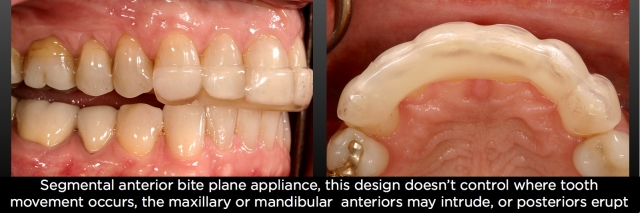
As originally published, the technique used a segmental anterior appliance, which allowed for intrusion of worn maxillary or mandibular anterior teeth, or eruption of maxillary or mandibular posterior teeth. Any of those possibilities creates room to restore the worn anterior teeth, but unfortunately doesn’t necessarily position the previously worn teeth where you may want them.
Where I have used the technique successfully has been by using a segmental posterior appliance to get incisor eruption or posterior intrusion to close open bites that have developed in adults after TMJ changes — specifically, cases of degenerative joint disease, and also in the acute bilateral loss of the disks following trauma, and therefore a loss of the joints’ vertical dimension, leading to a subsequent anterior open bite.
In all the cases I have used it, there was no pain involved, only the development of the open bite.
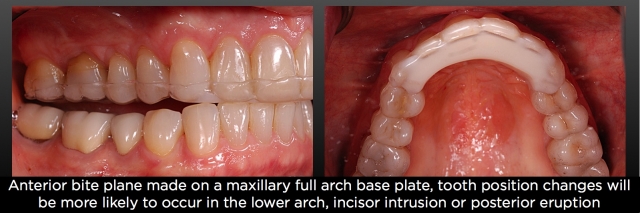
In my experience, what has worked successfully to limit the changes in tooth movement (primarily to the lower arch) and therefore have less esthetic risk, is to use a full-arch base plate on the maxillary arch, and then build up the posterior pivot on the base plate to provide the posterior occlusal contact. This minimizes the risk of changes in maxillary tooth position, but allows for some mandibular posterior intrusion, or mandibular incisor eruption, to close the open bite.
I have also found, as you would expect, that the more the patient wears the appliance, the faster the changes occur. Having said that, the patients I have treated almost universally did not wear it during the day, yet still got the desired change in the occlusion.
I am attaching a few cases to illustrate the challenges of the technique, but also how it can be used successfully.
The first patient presented to me years ago wearing a cast metal posterior pivot appliance, sometimes referred to as a Gelb appliance. The appliance has only posterior occlusal contact, and the anterior teeth are free to move independently from the posterior teeth.
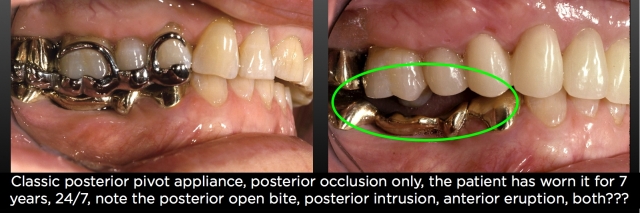
This appliance is typically fabricated for patients with specific TMJ issues concerning pain, and can be quite effective at providing pain relief, but with massive side consequences if the patient isn’t carefully monitored.
This patient had worn the appliance for more than seven years, 24 hours a day, and as you would expect, she now has a posterior open bite of several millimeters when she removes it.
The next case shows how significant the risks of segmental appliances can be. The patient’s dentist fabricated the appliance because she was in pain. When the posteriors would intrude or the anteriors would erupt so she had anterior contact, he would add to the posterior appliance to eliminate the anterior contact.
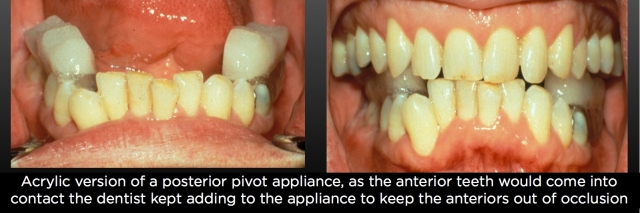
Naturally, this allowed for further posterior intrusion or anterior eruption, leading to another round of additions. The photos tell the rest of the story.
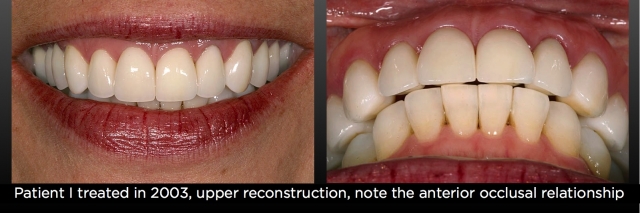
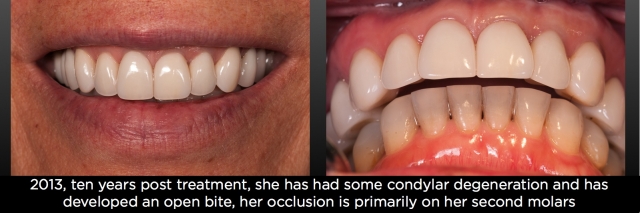
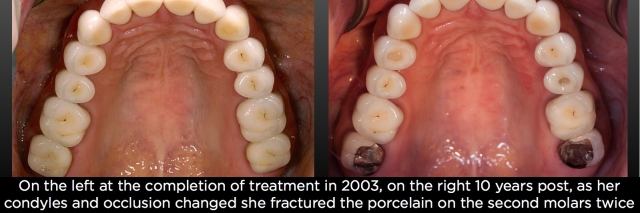
The third case is a patient I did an upper reconstruction on in 2003. Around 2008, she fractured porcelain on the maxillary second molars, which I replaced. A few years later she broke them again, so I redid them with metal occlusals.
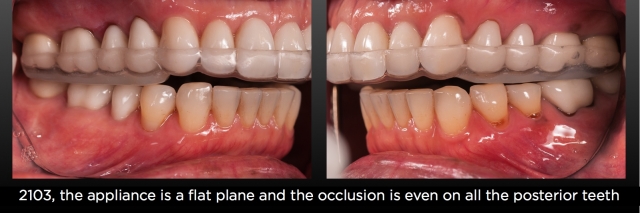
Ultimately, it turned out she had degenerative joint disease and was losing joint height, but was otherwise asymptomatic. By 2013, she had a significant anterior open bite and almost all her occlusion was on the second molars.
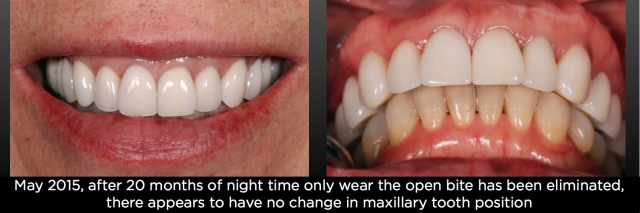
Her history was almost identical to several other patients I treated using segmental posterior appliances, which is what I fabricated for her in August 2013. She wears the appliance religiously every night, but not at all otherwise. I just saw her last week in the office and the open bite is completely closed, with no apparent change in the maxillary tooth position due to the fact that the appliance covers all the maxillary teeth.
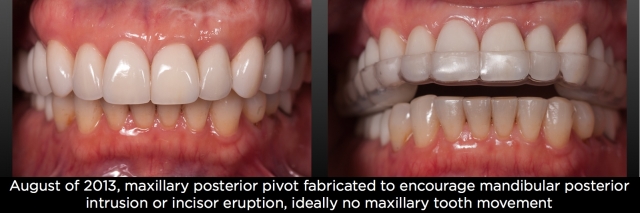
The key now is to be careful she doesn’t start to develop a posterior open bite. To that end, I will carefully monitor her, and if the posterior occlusion starts to open when the appliance is out, I’ll make her a traditional full-coverage appliance.
Hope this helps some of you with creative ideas for the use of segmental posterior appliances, but always carefully monitor your patient for undesired occlusal changes.
SPEAR campus
Hands-On Learning in Spear Workshops
With enhanced safety and sterilization measures in place, the Spear Campus is now reopened for hands-on clinical CE workshops. As you consider a trip to Scottsdale, please visit our campus page for more details, including information on instructors, CE curricula and dates that will work for your schedule.

By: Frank Spear
Date: September 15, 2017
Featured Digest articles
Insights and advice from Spear Faculty and industry experts