Three Steps to Accurately Mounting Models
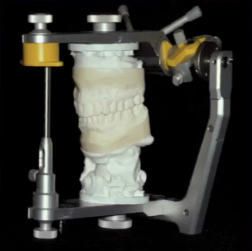
In previous articles, I’ve covered the topic of mounted models and their importance in treating clinical cases accurately and efficiently. Once you’ve completed the process of producing the patient’s centric relation bite records, it’s now time to use the records to actually mount the models.
Because these are diagnostic models, you’ll most likely be completing this process in-house by either yourself as the clinician mounting the models or delegating it to one of your staff members. This process is not as easy as just taking the records, sticking the models on the articulator and throwing stone; there are a few steps that you need to take first.
1. Evaluate and clean up models
I take all of my diagnostic impressions with alginate, although a silicone or an alginate substitute could also be used. Before mounting, make sure no bubbles are on the occlusal surfaces of the models. If you don’t pay attention to the bubbles, the records won’t accurately fit on the models, leading to inaccurate mountings. To clean the models, use a cleoid discoid or a carver with magnification.
2. Trim the silicone record
If you used wax to create your CR record, the wax is generally ready to be used for mounting with no adjustment necessary. However, if you used silicone to make the CR bite records, there are a few extra steps that you need to take prior to mounting.
Silicone is an excellent material for taking bite records; the problem is that it’s actually too accurate, compared with the accuracy of the stone models. Before mounting, we need to remove some of the accuracy of the record.
- First, trim off any part of the bite record that touches soft tissue. Generally, I will trim the distal of the record through the distal cusp of the last tooth.
- The next step usually involves using a scalpel blade to cut the thickness of the material down until I have cusp indentations of 1–1.5 mm. The purpose of this is to visually allow you to confirm that the model is seated completely in the record.
- The last step in the trimming process is to use an acrylic bur to remove the primary and secondary anatomy from the record, as well as the occlusal embrasures, because these areas on the model will not be as accurate as the record.
The goal for a properly trimmed record is the have the model seated in the record touching only the cusp tips. How do you know when you’ve trimmed enough? The only way to know is to try it back on the model and make sure there isn’t any “bounce” between the upper and lower models. If there is, go back to the models and record, evaluate them both, and adjust accordingly.
3. Mount models
Once the records are trimmed, the maxillary model is mounted first, using the facebow. Once the upper is mounted, you’ll mount the lower model using centric relation bite record. Because the bite record is taken at a more open vertical dimension, be sure to open the pin on the articulator 3–4 mm to accommodate for the thickness of the record. This allows the pin to approximate zero when the models are mounted. It’s OK if the pin isn’t exactly at zero — you just want it to be close.
SPEAR campus
Hands-On Learning in Spear Workshops
With enhanced safety and sterilization measures in place, the Spear Campus is now reopened for hands-on clinical CE workshops. As you consider a trip to Scottsdale, please visit our campus page for more details, including information on instructors, CE curricula and dates that will work for your schedule.

By: Greggory Kinzer
Date: May 10, 2013
Featured Digest articles
Insights and advice from Spear Faculty and industry experts