Demystifying Manipulation for Obtaining Centric Relation
In previous articles, I covered the topic of producing centric relation records for a functional analysis. I’ve also mentioned multiple methods that can be used as a clinician to help ease patients who experience tension or tenderness when trying to find CR. While using a Lucia jig, leaf gauge, and manipulation have all proven to be successful methods to obtain CR, the manipulation technique may prove to be the most difficult to master for some.
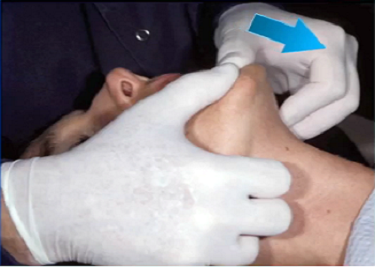
Bimanual manipulation, as made most notable by Dr. Pete Dawson, can be quite frustrating for many clinicians because it takes time to learn how to perform properly. This technique requires you as the clinician to seat the condyles in the fossa by stretching the lateral pterygoid.
Hand position for manipulation is crucial; the pinkies and ring fingers need to be placed around the distal border of the angle of the ramus, with the index and middle fingers anterior to it and the thumbs placed on the chin. This positioning allows the correct direction of force from the fingers to seat the condyles. A common error is to have the fingers too far forward on the jaw. If this occurs, the only thing you can do is hinge with the patient. You can’t apply the correct direction of force to seat the condyles.
To make this technique easier, you can position that patient on their back, with their head level to your arms positioned at a 90° angle. Have them tilt their head back and place your hands on the mandible, with the fingers distal enough to cradle the angle of ramus and to provide the correct orientation and direction of the force. Again, it is the force from the clinician’s fingers that will seat the condyles in the fossa.
Material of choice
Wax, not silicone, is typically the bite registration material of choice when using manipulation. I typically use Delar bite registration wax, which comes preshaped and pretapered and sets very hard. The thinner part of the wax wafer is positioned on the posterior teeth with the thicker part being positioned anteriorly. Unlike some other waxes, the Delar wax has a long latent heat, which provides a long working time.
I use a butane torch to warm the wax before taking the record. This enables me to heat only the areas that will be used to record the teeth, thereby minimizing the volumetric expansion and contraction of the wax that would occur if the entire wafer was heated in a water bath. The key when heating the wax is to apply the heat slowly, in multiple additions, to prevent the surface wax from melting too quickly and dripping.
Although there are many variations that can be used when creating the bite record, I typically will seat the wax against the upper teeth myself, creating the indentions with force from my fingers. When seating the wax in the patient’s mouth, it’s important to place it distal to the canines to prevent the patient from occluding on the central, unheated part of the wax. While my assistant holds the wax on the upper arch, I will place my hands in the correct position to start manipulating.
Get deep-enough indentations
As the patient opens and closes, I apply an increasing amount of force to ensure proper seating of the condyles. Our job is to seat the condyles while the patient lightly squeezes to create the indentations into the wax. At this point, you want to get deep-enough indentations that will allow the record to easily be repositioned on the teeth. It is imperative that the patient not bite completely through the record, even in one spot. If this occurs, throw the record away and start again.
After making the initial indentations, you’ll want to remove the wax to allow you to trim it. The purpose of this is to cut the wax through the central grooves of the maxillary teeth. This will allow you to better visualize the seating of the model into the wax during the mounting process. This process of trimming the wax will also distort the record. To remove any of the distortion, the record must be taken back to the patient’s mouth. I typically do not heat the wax again, but rather seat it against the upper teeth and start manipulating the patient. While manipulating the patient, I will ask them to squeeze into the wax — not to create “new” indentations but rather to remove any distortion that occurred in the trimming process. The wax can now be cooled with the air/water syringe while in the mouth under compression.
At this point, the patient should be able to open and close on their own accord and hit the same indentation in the record every time. It’s important to keep the record in a baggie of water to help prevent any distortion of the wax before mounting.
The next step is to create another CR record using the same technique. This will enable you to mount with one record and use the second CR record to verify that you have a repeatable position of closure. If the two bite records are determined to “match” during the verification process after mounting, you have successfully created repeatability of closure in the CR position.
SPEAR campus
Hands-On Learning in Spear Workshops
With enhanced safety and sterilization measures in place, the Spear Campus is now reopened for hands-on clinical CE workshops. As you consider a trip to Scottsdale, please visit our campus page for more details, including information on instructors, CE curricula and dates that will work for your schedule.

By: Greggory Kinzer
Date: June 22, 2017
Featured Digest articles
Insights and advice from Spear Faculty and industry experts