- Article
- DSOs
Clinical Growth in DSOs: An Executive’s Guide
Daniel Butterman
•
June 30, 2026

The real challenge isn’t growing a DSO. It’s scaling one.
As organizations add locations, providers, and technology, complexity increases. Associate ramp times stretch longer than expected. Treatment philosophies begin to vary across locations. Technology adoption slows. Clinical leaders spend more time managing inconsistency than driving growth.
Yes, the organization is expanding, but alignment isn’t always keeping pace.
That’s why clinical growth in DSOs has become one of the most important conversations in enterprise dentistry.
The challenge is not a lack of talent. It’s the absence of a scalable system that prevents providers from developing consistently, aligning around a common standard of care, and delivering a predictable patient experience across the organization.
The financial impact is significant.
Without a structured development system, Spear has found that the average DSO loses more than $700,000 in year-one production per 10 associates due to slow ramp-up times, clinical variability, and missed treatment opportunities.
By contrast, organizations that invest in structured clinical growth systems have reported up to $2,200 per day in increased doctor production, 32% improvements in case acceptance, and more than $250,000 in annual production gains per associate by year two.
Many DSO and DPO leaders eventually discover the same reality: Recruiting creates capacity. Clinical growth creates performance.
Clinical growth influences associate productivity, case acceptance, provider retention, technology adoption, leadership development, and clinical consistency across every location. It creates the foundation that allows organizations to scale without sacrificing quality.
A structured clinician development strategy is becoming less of a competitive advantage and more of a prerequisite for sustainable growth.
What is clinical growth in DSOs?
Clinical growth in DSOs is the process of helping providers develop clinical judgment, communication skills, confidence, and consistency needed to perform at a higher level across a growing organization.
The strongest organizations view it as a system, not a development program. A system that helps clinicians diagnose more comprehensively, communicate more effectively, align around a common standard of care, and create a more consistent patient experience regardless of location.
“We had no platform to up-level them at all. We had no way to standardize it to make sure they were hearing the same thing,” said Dr. Anthony Ponzio, Clinical Director, P1 Dental Partners.
Without a system, growth creates variation.
With it, growth creates momentum.
Clinical growth in DSOs connects education to real-world outcomes, including faster associate onboarding, stronger case acceptance, improved provider retention, better technology adoption, and more predictable enterprise performance.
In other words, clinical growth is not simply about helping clinicians learn more. It’s about helping an organization scale excellence.
Why has clinical growth become a strategic priority for DSOs?
Growth changes the challenges a DSO must solve.
As organizations add providers, locations, and technologies, clinical performance becomes harder to manage through informal mentorship or individual leader oversight alone.
What once worked through proximity, shared habits, and local relationships eventually requires repeatable systems.
This is why clinical growth in DSOs has evolved from a continuing education initiative into a strategic business priority.
Without structured development frameworks, organizations frequently encounter:
- Extended associate ramp times
- Inconsistent treatment planning
- Clinical variability between locations
- Uneven patient experiences
- Leadership bottlenecks
- Higher turnover rates
- Slower technology adoption
These challenges affect far more than clinical outcomes. They influence recruiting costs, provider retention, operational efficiency, production growth, and ultimately enterprise value.
As organizations expand, maintaining a consistent standard of care becomes increasingly difficult. New associates enter the workforce with varying levels of clinical experience. Technology investments require ongoing training and adoption. Future clinical leaders must be identified and developed long before they are needed.
“I quickly realized we didn’t have the resources or infrastructure to onboard and fully support dentists coming out of school and hold them to a standard of care.” — Dr. Traci Portnoff, Director of Doctor Development, Select Dental Management
Many organizations discover these challenges only after growth exposes them. By then, onboarding inefficiencies, clinical variability, and leadership gaps are already affecting performance.
The most successful organizations take a different approach. They treat clinical growth as a proactive strategy to scale provider performance, strengthen consistency, and prepare the organization for future growth. Rather than waiting for complexity to create problems, they build development systems that help growth happen more predictably and profitably.
What are the biggest barriers to clinical growth in DSOs?
As DSOs grow, clinical development becomes increasingly complex. Expanding across multiple locations, integrating new providers, and maintaining consistent standards of care require more than strong recruiting and operational processes.
Many organizations encounter common obstacles that limit provider performance, slow growth, and create variability across the enterprise. Understanding these barriers is the first step toward building a scalable clinical growth strategy.
Associate ramp time
Many new dentists enter practice with limited experience managing complex treatment plans, patient communication challenges, and production expectations.
Without structured support, new associates often require months or years to reach full productivity. Across a growing organization, those delays compound quickly. Every extended ramp period represents unrealized production, increased leadership burden, and a greater risk of early turnover.
A structured development framework helps organizations shorten the gap between hiring a provider and realizing the provider’s full potential.
Clinical inconsistency
As organizations grow, treatment philosophies often vary by location, provider, or region. This inconsistency affects:
- Patient experience
- Case acceptance
- Referral patterns
- Clinical outcomes
- Operational efficiency
Organizations that lack a shared clinical framework often struggle to create predictable results across the enterprise.
A shared clinical framework gives leadership a way to create alignment before inconsistency becomes embedded in systems, teams, and culture.
Technology adoption gaps
Technology investments frequently fail to deliver expected returns because organizations focus on implementation rather than adoption.
Without training, accountability, and leadership alignment, even the most advanced technology platforms may produce inconsistent results.
The longer adoption gaps persist, the harder they become to correct. Technology investments are most effective when organizations establish the framework, accountability, and shared expectations needed to turn implementation into consistent behavior.
Leadership bottlenecks
As organizations grow, leadership needs expand. Without a pipeline of mentors, regional directors, and clinical executives, growth can outpace an organization’s ability to maintain consistency and support for providers.
Provider retention
Replacing clinicians is expensive. Recruiting, onboarding, credentialing, and ramping a new provider requires significant investment. Organizations that fail to support professional development often struggle to retain top performers.
How does associate development support clinical growth in DSOs?
Associate development is often the highest-leverage investment a DSO can make. The first year of practice frequently determines long-term success. New clinicians need support that extends beyond technical skills.
Effective associate development programs help providers:
- Increase productivity
- Improve treatment planning
- Strengthen patient communication
- Develop clinical judgment
- Integrate into organizational culture
- Build confidence
“I’ve always said it takes three to five years for a dentist to really feel comfortable when they’re out of school. I really think we can cut that timeline in half.” — Dr. Anthony Ponzio, Clinical Director, P1 Dental Partners
Organizations that provide structured development programs frequently achieve faster time-to-productivity and stronger retention than those that rely solely on informal mentorship.
The goal is not simply to help associates become productive. The goal is to help associates become productive, consistent, and aligned with organizational standards.
As Select Dental Management expanded across 38 practices in the Northeast, maintaining a consistent clinical standard became more difficult. Dr. Traci Portnoff, Director of Doctor Development, saw talented clinicians working hard without a shared system for mentorship, clinical standards, or long-term growth.
Select Dental Management partnered with Spear to launch a pilot program for 10 doctors focused on associate onboarding, CE, and leadership development.
Instead of relying on office-by-office mentorship, Spear helped build a shared clinical framework that aligned treatment planning, restorative standards, and patient care across practices.
Spear supported the organization in two key ways:
- Clinical Alignment: Spear’s Facially Generated Treatment Planning aligned with the organization’s Clinical Advisory Board, creating a shared framework for diagnosis, communication, and quality expectations.
- Operational Scalability: Spear Online helped doctors track their CE progress, prepare for procedures, and build skills without relying entirely on senior clinicians.
To strengthen collaboration and accountability, Dr. Portnoff launched an internal Spear Study Club where clinicians could discuss cases, share insights, and reinforce a common standard of care.
The program quickly became a recruiting and retention advantage, attracting new graduates while re-engaging experienced clinicians through mentorship and collaboration.
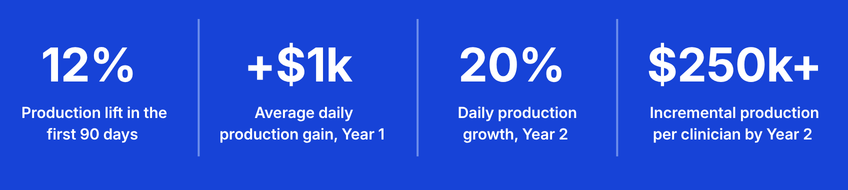
Three years into implementation, Select Dental Management achieved measurable clinical and operational growth.
- Repeat cohort doctors increased production per day by approximately 20%.
- New cohort doctors achieved an average 12% increase in daily production within three months, equating to roughly $1,000 more per doctor per day.
Why is clinical consistency critical for scalable growth?
Clinical consistency is one of the most important indicators of organizational maturity.
“Consistency is one thing. Calibration is another.” — Dr. Ray Scott, Chief Clinical Officer, North American Dental Group
As organizations expand across markets, maintaining consistency becomes increasingly difficult.
Different providers may recommend different treatment approaches for similar cases. Teams may communicate differently with patients. Operational workflows may evolve independently.
These inconsistencies create friction throughout the organization. Patients notice inconsistency. Teams notice inconsistency. Leadership notices inconsistency.
Operational inconsistency becomes increasingly expensive as organizations scale. Research on multi-site health care systems has shown that organizations that successfully standardize operations across facilities can achieve 12% to 18% cost reductions while improving operational efficiency and quality outcomes.
Conversely, fragmented processes, duplicate workflows, and inconsistent standards often create unnecessary complexity, limiting the benefits of scale.
The highest-performing DSOs create systems that support consistency while allowing clinicians to maintain professional autonomy.
As Dr. Scott explains, “We have a consistent message, consistent opportunities across the board for a doctor, regardless if you’re practicing in Chicago or Orlando.”
Those systems often include:
- Standardized onboarding
- Shared treatment planning frameworks
- Clinical governance structures
- Performance scorecards
- Peer mentoring programs
- Enterprise-wide education pathways
Consistency creates predictability, and predictability creates scalability.
For many organizations, clinical inconsistency remains invisible until growth exposes it. A five-location organization may absorb variation. A 50-location organization cannot.
The longer inconsistency persists, the harder it becomes to standardize workflows, develop future leaders, and maintain a shared standard of care. That’s why leading organizations increasingly view clinical growth in DSOs as a proactive investment rather than a corrective measure.
“Consistent language is a huge part of co-discovery,” said Dr. Allison Besse, a Select Dental Management provider. “My hygienists and I are aligned, so patients aren’t hearing different messages from different providers. We’re using the same evidence-based approach and terminology, which helps patients better understand their treatment options.”
How does technology support clinical growth in DSOs?

Many organizations invest heavily in digital platforms, imaging systems, communication tools, and workflow technology. Yet technology delivers value only when clinicians consistently incorporate it into their daily practice.
Technology alone does not create growth. Adoption creates growth.
Organizations that connect technology adoption to clinician development typically achieve stronger long-term ROI than organizations that treat implementation as an isolated project.
Technology helps reinforce standardized workflows, treatment planning protocols, and organizational knowledge, creating a more consistent experience for both providers and patients.
As organizations grow, onboarding new clinicians becomes increasingly complex. Every new associate must understand clinical expectations, workflows, communication standards, and treatment planning protocols.
Organizations that can standardize these learning experiences across locations often reduce onboarding variability and help associates reach productivity expectations more quickly.
A well-designed technology approach helps standardize these processes.
Technology can support:
- Faster clinician onboarding
- Standardized treatment planning
- Consistent patient communication
- Clinical calibration across locations
- Reduced workflow variation
- Improved access to organizational knowledge
For growing organizations, reducing onboarding friction can have a meaningful impact on productivity and retention.
“Technology implementation is not an IT project. It’s a leadership and change-management initiative,” says Dr. Vishal Sharma, Director of Education & Operations at Spear Education.
Sustaining adoption also requires long-term commitment. Organizations that invest in ongoing clinician development, leadership training, and standardized learning pathways are better positioned to maintain consistency, improve performance, and maximize the value of their technology investments.
Why does leadership development matter for clinical growth in DSOs?
Every growing DSO eventually reaches a leadership threshold. At some point, clinical growth can no longer depend on a handful of highly engaged leaders. The organization must create systems that develop future leaders.
Strong clinical leadership influences:
- Clinical consistency
- Associate onboarding
- Technology adoption
- Governance
- Organizational culture
This is why many organizations are investing in leadership pathways for:
- Regional clinical directors
- Clinical mentors
- Chief dental officers
- Chief clinical officers
The organizations that scale most effectively build leadership capacity before they need it. Executives building that pipeline can share Dr. Sharma’s guide on how to become a chief clinical officer with clinicians who show leadership potential.
“As we’ve transitioned from some of the senior docs who are at their five- or six-year point in retiring to younger docs, it’s more important than ever for us to have standardization.” — Dr. Anthony Ponzio, Clinical Director, P1 Dental Partners
Future clinical leaders cannot be developed overnight. Mentors, regional directors, and chief clinical officers require years of experience, coaching, and support. A structured leadership development strategy helps organizations build that pipeline before expansion exposes costly, difficult-to-fill leadership gaps.
Waiting until growth creates leadership gaps is often too late. Clinical directors, mentors, and future chief clinical officers require years of development, not months. Organizations that invest early in clinician development are better positioned to create leadership pipelines that support expansion, protect culture, and maintain consistency as they grow.
“The organizations that outperform their peers recognize that development is equally important as recruiting,” says Dr. Sharma.
What metrics should executives use to measure clinical growth in DSOs?
What gets measured gets improved.
Clinical growth in DSOs is most effective when clinician development is tied to measurable business outcomes. Organizations that establish clear performance metrics can evaluate progress, identify gaps, prioritize investments, and understand how development initiatives influence provider performance, operational consistency, and financial results.
High-performing organizations track metrics that connect associate development, clinical performance, technology adoption, patient experience, and profitability. These measurements help leaders determine whether clinical growth initiatives are creating meaningful value across the enterprise.
|
Category |
KPI |
Why It Matters |
|---|---|---|
|
Associate Development |
Time-to-Productivity |
Measures how quickly new associates reach expected production levels. |
|
First-Year Retention |
Indicates onboarding effectiveness and reduces replacement costs. |
|
|
Competency Achievement |
Tracks clinical skill development and readiness milestones. |
|
|
Associate Satisfaction |
Measures engagement and helps identify retention risks. |
|
|
Clinical Performance |
Production per Day |
Evaluates provider productivity and revenue generation. |
|
Production per Hour |
Measures efficiency and clinical workflow effectiveness. |
|
|
Case Acceptance |
Indicates treatment planning effectiveness and patient communication success. |
|
|
Referral Utilization |
Reveals opportunities to expand clinical capabilities and retain treatment in-house. |
|
|
Clinical Consistency |
Treatment Planning Variation |
Measures alignment across providers and locations. |
|
Clinical Rework Rates |
Identifies variability, quality issues, and margin leakage. |
|
|
Standard-of-Care Compliance |
Assesses adherence to organizational clinical protocols. |
|
|
Technology Adoption |
Platform Utilization |
Measures engagement with clinical and operational technologies. |
|
Workflow Adoption Rates |
Indicates whether technology investments are being integrated into daily practice. |
|
|
Operations |
Chair-Time Utilization |
Evaluates scheduling effectiveness and production capacity. |
|
Workflow Efficiency |
Measures consistency and operational performance across locations. |
|
|
Provider Capacity Utilization |
Helps determine whether clinicians are operating at expected productivity levels. |
|
|
Patient Experience |
Treatment Acceptance |
Reflects patient trust and understanding of recommendations. |
|
Patient Satisfaction |
Measures overall experience and loyalty. |
|
|
Recall Retention |
Indicates long-term patient engagement and continuity of care. |
|
|
Leadership Development |
Internal Promotion Rate |
Measures the strength of the organization’s leadership pipeline. |
|
Mentor Participation |
Tracks engagement in leadership and clinician development programs. |
|
|
Financial Performance |
Production Growth |
Measures the revenue impact of clinical development initiatives. |
|
Provider Retention Cost Savings |
Quantifies reduced recruiting, onboarding, and vacancy expenses. |
|
|
EBITDA Contribution |
Connects clinical growth initiatives to enterprise profitability. |
|
|
Return on Investment (ROI) |
Measures the overall business impact of clinical growth programs. |
What does a clinical growth operating system look like?
Leading DSOs increasingly view clinical growth as an integrated operating system rather than a collection of isolated initiatives.
“Our doctors who invest in their education are our top producers. They’re excellent clinicians, and that translates into productivity.” — Dr. Traci Portnoff, Select Dental Management
That operating system typically includes four interconnected pillars:
- Associate development: Structured onboarding and clinician growth pathways.
- Clinical consistency: Shared treatment planning frameworks and clinical standards.
- Technology enablement: Technology adoption supported by training and accountability.
- Leadership development: Programs that create future clinical leaders and mentors.
Together, these pillars create a framework that supports growth across the enterprise. When one pillar is missing, scalability becomes more difficult. When all four are aligned, organizations create a foundation for sustainable long-term growth.
How can executives evaluate a clinical growth strategy?
When evaluating clinical growth initiatives, executives should focus on outcomes rather than activities. Key questions include:
- Will this reduce associate ramp time?
- Will this improve provider retention?
- Will this increase consistency across locations?
- Will this support technology adoption?
- Will this develop future leaders?
- Will this improve productivity?
- Can it scale across the organization?
- Can outcomes be measured?
The strongest clinical growth strategies connect clinician development directly to organizational performance. That connection is what transforms clinical growth from a cost center into a strategic growth lever.
“The question is no longer whether DSOs need strong clinical leadership. The question is whether they are investing in the systems and capabilities that allow clinical leadership to scale with the business,” said Dr. Sharma.
Explore DSO clinical growth with Spear’s resource library
- The Missing Link in DSO Growth: Doctor Development
Doctor development in DSOs improves recruiting, retention, and production through a scalable education model that drives measurable growth.’ - Smart DSO Technology Strategy That Actually Scales
Learn how a successful DSO technology strategy improves adoption, clinician performance, patient experience, and measurable ROI. - Chief Clinical Officer Training for DSO Growth
Learn how chief clinical officer training helps DSOs improve EBITDA, retention, onboarding, governance, and clinical consistency at scale. - Become a Chief Clinical Officer: The Essential DSO Skills
Learn the skills dentists need to become a chief clinical officer, from mentorship and calibration to KPIs, plus the path from chair to C-suite. - Dental Associate Ramp Time: How DSOs Accelerate Growth
Hear how one DSO reduced dental associate ramp time through structured clinical development to improve productivity and consistency. - Associate Foundations Program
Learn more about how to cut dental associate ramp time in half to accelerate profitability and standardize performance across locations. - Tailored Solutions for Growing DSOs
Find out how Spear can help you build a repeatable system that reduces risk, scales consistency, and accelerates growth. - Elite Dental Partners Case Study
One DSO was challenged by onboarding new doctors. Spear helped standardize their onboarding and CE between all their practices. - Success Stories
Discover how DSOs are transforming their operations to achieve exceptional clinical outcomes, team performance, and productivity with Spear.
The future of clinical growth in DSOs
The challenge facing most DSOs is not finding growth opportunities. It’s building the systems that allow growth to scale without sacrificing consistency, quality, or culture.
As organizations add providers, locations, and technologies, complexity increases. Without a structured approach to clinician development, that complexity often manifests as longer associate ramp-up times, inconsistent patient experiences, leadership gaps, and operational variability across the organization.
“I’ve always felt like you need to have a clinical platform. You need to have ground zero, a compass, if you will.” — Dr. Scott Dudley, Founder and CEO, Branin Dental Group
The highest-performing DSOs recognize that clinician development is not a training initiative. It’s strategic infrastructure.
Organizations that invest in associate development, clinical consistency, technology adoption, and leadership pathways create an environment in which providers can perform at a higher level, and patients receive a more consistent standard of care regardless of location.
The result is a much stronger clinical performance. It’s faster onboarding, higher retention, greater operational alignment, and a foundation for sustainable enterprise growth.
The organizations that lead the next decade of dentistry will not simply be the ones that acquire the most practices. They’ll be the ones that create repeatable systems for developing people, aligning care, and scaling performance across every location they support.
Clinical growth in DSOs is ultimately about turning individual provider potential into organizational capability. And for leaders focused on long-term growth, that may be one of the most valuable investments they can make.
Frequently Asked Questions
Spear Enterprise
Standardize Clinical Quality Across Every Location
When every doctor ramps up differently, production and clinical consistency vary from practice to practice. Spear provides your organization with structured onboarding and role-based training pathways, so new doctors reach full productivity faster, and every location upholds the same clinical standard.
The result: up to $2,200 per day in increased doctor production.
Featured Digest articles
Insights and advice from Spear Faculty and industry experts