- Article
- Practice Management
Your Dental Patient Pyramid
Michael Monokian
•
August 9, 2017
This is the second installment of a series of articles on implementation. The first article is called “Are you a CE Junky?” I’d recommend reading it prior to proceeding.
I’ve asked numerous doctors: What prevents you from doing comprehensive care in your practice? What holds you back from implementing the type of care we learn at Spear?
The number one answer? You guessed it: INSURANCE. In particular, the reimbursement from insurance.

We’ve all heard it from our patients: ”Will my insurance cover that?”
It can become painful to hear, but the truth is, as long as we live in a world where dental insurance exists, they’ll never stop asking.
So, is insurance a roadblock to implementing comprehensive dentistry (like we learn at Spear) in a general practitioner’s office? I believe the answer is yes and no.
The Role of Insurance in Comprehensive Dentistry
Participating with SOME insurance companies that reimburse fairly is a logical consideration. However, I also think that every practice should do a thorough production analysis regarding the following three types of patients:
- In-network patients
- Out-of-network patients
- Cash-paying patients
Along with the other owners in our practice, I meet once a month with our accountant. We constantly evaluate the value of these three types of patients.
In our experiences, patients with insurance tend to accept double the amount of treatment. This may be a sign that we aren’t doing a good enough job of instilling value in our cash patients, OR it could be that these patients feel a level of comfort knowing that their benefits will contribute to their overall cost.
We’d love to be insurance independent; however, that’s not a reality in our area. Some patients won’t try us unless they know we’re in network with their plan. The key is that we don’t fall into the insurance trap.
What is an insurance trap?
- You and the rest of the team have to understand that dental insurance is not insurance. It’s a benefit. And this needs to be explained clearly to your patients. I love the video by Imtiaz Manji titled “Talking To Your Patients About Insurance.” It will help your team understand that dental insurance isn’t insurance at all; it’s a benefit. And the benefits patients receive are meant to maintain their current health, NOT bring them to health.
- The biggest problem with dental insurance is an infection in the dental team’s mindset. Over time, when team members (including dentists) hear, “Will my insurance cover that?” they start to change their presentation style with patients. Instead of presenting what patients need, they start presenting what patients may accept based on their coverage.
This is a tough battle because dental benefits do play a role in some patients’ case acceptance. But they don’t play a role in ALL of our patients’ case acceptance.
The 5 Types of Dental Patients
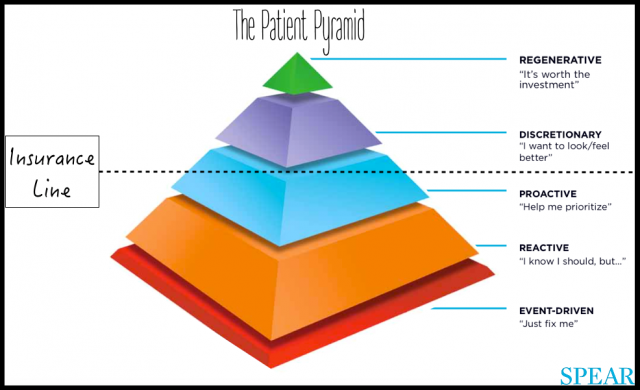
This is where the Spear Patient Pyramid really comes into play. Understand that patients are on different pyramid levels and have different value systems. As a quick overview, here is the pyramid:
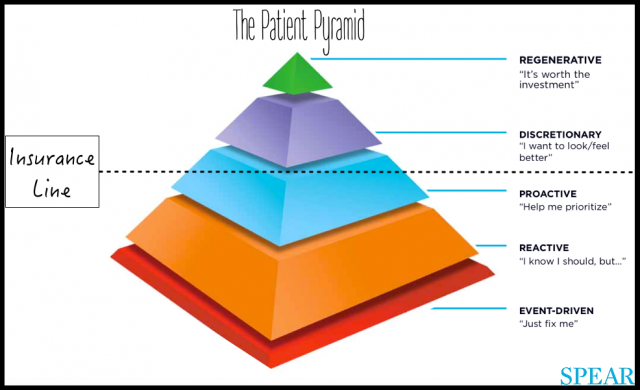
- Event-Driven Patients (a.k.a., emergency patients) are looking for us to perform triage and usually don’t come in for hygiene.
- Reactive Patients are very insurance-driven and sometimes come in for hygiene, but they definitely only accept single-tooth care, and sometimes, they won’t even accept that.
- Proactive Patients are still somewhat insurance-driven but typically come in every six months for hygiene and complete the treatment they’ve accepted. There is a gray area for these patients regarding accepting comprehensive care.
- Discretionary and Regenerative patients are typically looking for esthetic and the best rehabilitative care they can receive. They may have dental insurance, but they understand that it has minimal impact on their treatment costs.
The Spear Patient Pyramid teaches us some incredible lessons:
First, it has nothing to do with how much money a person makes. I have school teachers who have done full mouth reconstructions, and I’ve had doctors and lawyers who only come in for emergencies. The pyramid has everything to do with how much people value dentistry.
Second, the pyramid is present in EVERY dental practice, although the shape may depend on the practice type.
Obviously, most of us would like to see and treat more Discretionary and Regenerative patients; however, in a general dental office like mine, we need to keep our chairs full and can’t pay all the bills waiting for those people to walk through the door. We rely on every tier to help keep our schedules full and keep ourselves profitable (including patients who rely on their dental insurance).
Finally, understand that just because someone may be reactive today doesn’t mean they can’t become regenerative tomorrow.
For example, if a patient has been proactive their whole life, they’ll most likely never need to be regenerative because they’ve been taking care of all of their problems as they arise PROACTIVELY. The reality is that patients who are regenerative are most likely patients who were once event-driven or reactive in nature.
Communicating the True Value of Dental Treatment to Patients
College, weddings, kids, health issues, family problems… the list goes on. Can you blame patients for sometimes putting off their dental care to get through these times? These aren’t excuses; these are reality.
Our patients will value different things at different times in their lives. Labeling someone as reactive doesn’t mean they’re stuck there. It just means they are there for now. It’s important to recognize this and work AS A TEAM to determine the barriers to their treatment. Be there for your patient when they’re ready to move forward.
We try to do this at our 15-minute morning huddle to start the day. We don’t just want to know about outstanding treatment. We want to know about the barriers. Sometimes, it’s just a financial hurdle, but sometimes, it’s more complex than that.
Now, if the barrier to dental health is the newest iPhone, a Mercedes-Benz, or a vacation to Hawaii, you and your team should strive to show your patients the true value of a dental investment. Valuing products and social status over dental health should not be something WE view as a barrier to a patient’s dental treatment.
This doesn’t mean we put down those materialistic things, it just means that we have to continue to stress the importance of dental health so that patients value it more and more.
This article’s take-home message is that the pyramid exists within your practice. Unfortunately, patients aren’t walking in with nametags on to tell you what tier they’re in. It’s up to you and your team to determine what they value. You and your team must encourage patients to invest in their dental health, ignoring what insurance may or may not cover. Also, understand that life events WILL get in the way of people accepting treatment. Patients who genuinely want the care will eventually find a way to get it done.
SPEAR All access
One Membership, $555 More a Day
Practices on Spear All Access see a median daily production gain of $555, with a 9.9% median lift in hygiene production. That’s not from one course or one workshop. It comes from unlimited Spear and CDOCS workshops, the full online course library, role-based team training, practice analytics, and a dedicated Practice Growth Partner working with your team every month, all in one membership.
Featured Digest articles
Insights and advice from Spear Faculty and industry experts