- Article
- Esthetics
Facial Profile Evaluation: A Clinical Guide for Dentists
Frank Spear
•
January 22, 2016
Evaluating the facial profile is one of the most practical and informative steps a dentist can take before making any significant esthetic or occlusal treatment decision.
No two patients share the same facial profile, which means no single plan creates a beautiful smile for everyone. Effective treatment begins with understanding the individual in front of you.
In this article, I will walk through how to assess the facial profile using photographic landmarks and angular analysis, how to apply the esthetic plane as a complementary reference, and how these findings translate directly into treatment planning decisions ranging from restorative dentistry to orthognathic surgery.
As in my most recent article on evaluating vertical facial proportion, I will base this assessment on a photographic image, since most restorative dentists have one readily available rather than a cephalometric radiograph.
What is a facial profile evaluation?
A facial profile evaluation is a clinical assessment of the patient’s facial proportions, lip position, and jaw relationships viewed from the side. Dentists use facial profile analysis to identify esthetic and skeletal discrepancies that influence restorative treatment planning, orthodontic decisions, and orthognathic surgery recommendations.
How should dentists photograph the facial profile?
Before conducting any landmark analysis, consistent photographic documentation lays the foundation for an accurate assessment of the facial profile. Two photographs are particularly useful in clinical practice:
- Lips-at-repose photograph: This image captures how much tooth display exists when the patient holds their mouth naturally at rest. It can also reveal inconsistencies such as uneven tooth length or discrepancies between the upper and lower anterior teeth.
- Full-smile photograph: Evaluating the patient’s maximum smile provides information about overall tooth display and, when combined with a lateral view, contextualizes the lip position relative to the facial profile.
Once these images are captured, Keynote or PowerPoint can be used to draw reference lines and measure angles directly on the photograph. This approach makes profile analysis straightforward, reproducible, and easy to explain to patients.
What landmarks are used to evaluate the facial profile?
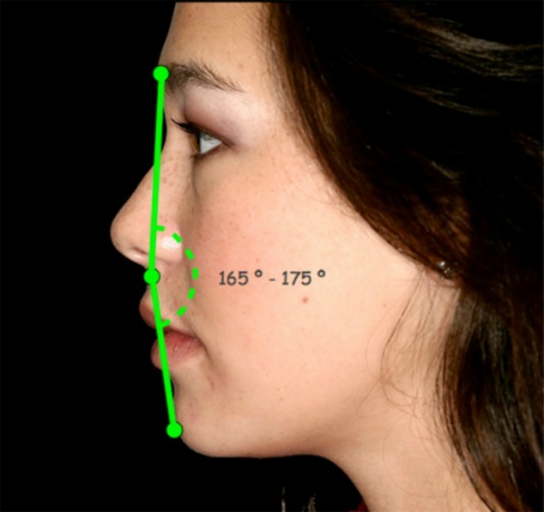
The evaluation of the facial profile begins by identifying three anatomical landmarks on the lateral-view photograph. Each point plays a specific role in defining the angle that characterizes the profile.
- Glabella: The prominent smooth area between the eyebrows where the forehead transitions down to the bridge of the nose.
- Subnasale: The point at which the nasal septum merges with the upper lip.
- Pogonion: The most anterior point on the contour of the chin.
How do you measure the facial profile angle?
After marking each reference point on the photograph with a small dot, draw a line from the glabella to the subnasale, then draw a second line from the subnasale to the pogonion.
The two lines meet at the subnasale and form the profile angle. A normal facial profile angle falls between 165 and 175 degrees. Computer presentation software makes calculating this angle fast and accurate.
What is the esthetic plane, and how is it used in facial profile evaluation?

A second reference tool that adds precision to the facial profile evaluation is the esthetic plane. This line connects the tip of the nose to the most anterior point of the chin.
In a well-proportioned facial profile, the upper lip sits approximately 4 mm behind the esthetic plane, and the lower lip sits approximately 2 mm behind it.
When the lips fall significantly in front of or behind these reference points, the profile tends toward convexity or concavity. This measurement serves as a useful check on the angular analysis and can surface esthetic concerns that the angle alone may not fully capture.
How does the facial profile influence treatment planning?
The facial profile angle has direct implications for how clinicians approach overjet, jaw discrepancies, and the role of surgery in an esthetic plan.
When the patient presents with a normal angle (165 to 175 degrees) and normal vertical facial proportion, orthognathic surgery would rarely be appropriate to correct existing overjet, because the profile is already pleasing, and surgery would likely compromise it.
A profile angle significantly below 165 degrees typically indicates a retrognathic mandible.
In a patient who also presents with excess overjet and a Class II dental occlusion, mandibular advancement may be a reasonable component of the treatment plan. The alternative, using maxillary first premolar extractions and retraction of the maxillary anteriors to manage overjet, solves the occlusal problem but can create a dental esthetic concern and leave a profile that’s less than ideal.
When the profile angle exceeds 180 degrees, this signals a deficient maxilla or a prognathic mandible.
If the patient also presents with an end-to-end or Class III anterior occlusal relationship, orthognathic surgery warrants serious consideration. Depending on the full analysis, the surgical plan could involve maxillary advancement, mandibular setback, or both, an approach that addresses the occlusion and produces a more favorable facial profile compared to a purely extractive and orthodontic solution.
Some patients present with an ideal occlusion but a facial profile that falls outside the normal range.
Normal is the center of a Bell curve, not a requirement for an attractive face. In cases where the profile deviation is the primary concern, targeted procedures such as genioplasty to reduce chin prominence or chin augmentation to increase it can produce meaningful esthetic improvements while leaving the occlusion entirely unchanged.
When should dentists evaluate the facial profile?
Learning to read the facial profile as a routine step in every esthetic and occlusal evaluation has been one of the most valuable diagnostic habits I’ve developed.
Facial profile and proportion assessment should precede any significant treatment decision that will alter anterior tooth position, vertical dimension, or the relative positions of the jaws. When the profile analysis indicates that orthodontics or orthognathic surgery should be part of the plan, involving specialists early yields far better outcomes than attempting to address a skeletal discrepancy through restorative work alone.
In my next article in this series, I will examine the relationship among the nose, lips, and chin as we continue to build a complete framework for evaluating facial esthetics.
Contributing Author
Dr. Mark Fleming
Frequently Asked Questions
SPEAR Membership
Try Spear Free For 7 Days
See what a Spear Membership can do for you and your team before you decide. A free 7-day trial gives you full access to Spear Online’s clinical CE courses and practice team training, so you can find the membership level that fits your practice.
Featured Digest articles
Insights and advice from Spear Faculty and industry experts