- Airway
- Article
Orthodontic Therapy and the Airway: An AAO White Paper Review
Jeffrey Rouse
•
July 1, 2020

Author’s note: The impact of tooth extraction on the airway can be very contentious. I hope this article serves as a tool to allow collegial discourse between restorative dentists concerned with the airway and the orthodontists they look to for solutions.
Recently, a new patient came to see me “looking for some veneers.” She had four bicuspids removed for orthodontics in the early 1970s and was given a headgear, but she routinely found it on the floor at night. Also, her tonsils and adenoids were removed when she was very young due to recurrent infections.
She complains of a lifetime of poor sleep and never feeling refreshed. She is on multiple high blood pressure medications and has reflux. Ten years ago, she was snoring so badly her husband requested a sleep study.
The study diagnosed her with snoring and apnea. The treatment was UPPP (palatal surgery) and repair of a deviated septum. She feels that she can breathe better than before the surgery, but the symptoms never cleared. She still snores and has unrefreshing sleep.
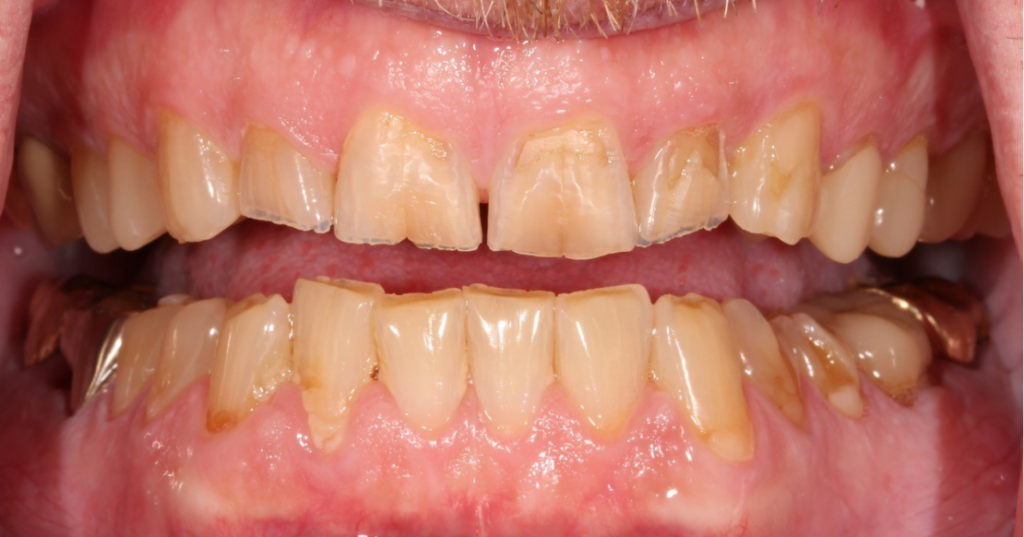
My examination revealed multiple teeth with recession, some significant, and generalized pathological wear and erosion. The maxillary anterior teeth were retroclined with lingual facets from pathway wear. The lower anteriors were overerupted. The tongue volume appeared normal, but the oral volume was limited. On examination, her airway was constricted, and her tongue was exaggeratedly retracted during examination of the oropharynx.
I thought, “Could the removal of four teeth and subsequent retraction of the anterior teeth be culpable in her medical and dental history?”
The OSA and Orthodontics Relationship Is Relatively New
In 2019, the American Association of Orthodontists (AAO) released its “Obstructive Sleep Apnea and Orthodontics” white paper. It was the culmination of a two-year project by a panel of sleep medicine and dental sleep experts. They were tasked to produce guidelines for the role of orthodontists in the management of obstructive sleep apnea (OSA).
Ultimately, the group could not develop any formal OSA guidance for orthodontists. This is interesting given that orthodontists manage the anatomy of the airway and work with medical providers on airway anatomy issues like cleft palates and orthognathic surgery.
While it was not stated in the paper, the lack of specificity of recommendations comes from the nature of the science being evaluated. When medical colleagues review dental literature, they are routinely struck by the poor quality of the data. Dental research is typically not well funded, the numbers of participants are limited, the follow-up is short, and it lacks untreated control subjects.
Orthodontics takes years to complete and many years to determine any impact. And finally, the relationship between OSA and orthodontics is a relatively new concept that has rarely been tested in sleep laboratories. Instead, most studies on airway change look at cephalometric or CBCT volumetric alteration and infer (albeit incorrectly) that bigger is better. Therefore, this lack of quality evidence will constrain the AAO white paper’s conclusions.
Bicuspid Extraction Addressed
Curiously, section 12 of the AAO white paper, “Fallacies About Orthodontics in Relation to OSA,” addresses the issue of bicuspid extraction. It begins, “Conventional orthodontic treatment never has been proven to be an etiologic factor in the development of obstructive sleep apnea. When one considers the complex multifactorial nature of the disease, assigning cause to any one minor change in dentofacial morphology is not possible.”
This conclusion is proper, but the keyword is “proven.” There is also a lack of proof that orthodontics is not a factor in the development of OSA. The disease is multifactorial, but minor changes in oral volume, vertical dimension, and mandibular protrusion have been shown to significantly affect the airway and sleep apnea. To argue that removal of four teeth is an unremarkable change is, at least, questionable given available data.
The paper continues, “The specific effects on the dental arches and the muscles and soft tissues of the oral cavity following orthodontic extractions can differ significantly, depending on the severity of dental crowding, the amount of protrusion of the anterior teeth and the specific mechanics used to close the extraction spaces.”
Zhiai Hu1 published a systematic review evaluating the effect of teeth extraction on the upper airway. It included only seven articles. They were divided by the reason for treatment:
- Class I bimax protrusion (four studies)
- Crowding Class I (one study)
- Unspecified (three studies).
The Class I bimax group all had anterior tooth retraction without boney changes. Three of the four articles showed a reduction in upper airway dimension, the last showed a reduction but not to the level of significance.
The one article on crowding differed because the orthodontic technique allowed the molars to move forward ~3.0 mm. That created an increase in the airway dimension.
Finally, the unspecified group did not discuss the direction of movement (retractive or molar movement) and found small increases for the extraction and non-extraction groups. A conclusion that can be reached from this review is that if you retract the anterior teeth, the airway size reduces, and if the molars move forward, the airway improves or remains the same.
Impact of Volumetric Change
The white paper goes on to state, “The impact that orthodontic treatment with or without dental extractions may have on the dimensions of the upper airway also has been examined directly, first with two-dimensional cephalograms and more recently with three-dimensional CBCT imaging…
“In discussing orthodontic treatment to changes in the dimensions of the upper airway, it also is helpful to understand that an initial small or subsequently reduced or increased size does not necessarily result in a change in airway function.”
This is one of the issues medicine has with dental literature. Dental researchers rarely study the actual impact of the volumetric change. It is not enough to say the space is smaller. It needs to be quantified with sleep data. It also needs to be followed over time.
However, Christian Guilleminault highlighted a reduction in the ideal size of the upper airway can lead to abnormal breathing over time, initially with flow limitation, then with a progressive worsening toward full-blown OSA.2> Rarely would testing at the completion of orthodontics demonstrate a compromise. It is the stressful breathing night after night that compromises the airway and makes people more prone to breathing issues during sleep.
Existing Evidence Suggests the Opposite
The AAO white paper highlights a paper that attempts to answer the question of compromise later in life.
“One such study assessed dental extractions as a cause of OSA later in life with a large retrospective examination of dental and medical records… The study concluded that the prevalence of OSA was essentially the same in both groups, and that dental extractions were not a causative factor in OSA.”
A.J. Larsen3 reviewed insurance records for 5,500 patients between the ages of 40-70. Dental radiographs determined if the subjects were missing four bicuspids or had a full complement of teeth. They matched the two groups for age, BMI, etc. Then they reviewed their medical records to see if the subject had received a diagnosis for apnea.
The results showed that 9.56% of the non-extraction and 10.71% of the extraction groups had a diagnosis of OSA, which was not significantly different. Thus, the authors concluded that there was no relationship between OSA and premolar extractions.
It is currently estimated that 80-90% of OSA patients are undiagnosed. Larsen’s paper states that because the subjects have insurance, they expect physicians to note the symptoms and get them a sleep study and diagnosis.
There is no evidence to support that assertion, and the existing evidence suggests the opposite. From pediatricians to primary care physicians, they are not effectively diagnosing apnea. This article should conclude that extraction and non-extraction individuals are underdiagnosed at almost the same rate.
Orthodontic Literature Is Not Conclusive
The AAO paper goes on to state, “Overall it can be stated that existing evidence in the literature does not support the notion that arch constriction or retraction of the anterior teeth facilitated by dental extractions, and which may (or may not) be the objective of orthodontic treatment, has a detrimental effect on respiratory function.”
Once again, it is true existing evidence does not support that position because there is no quality evidence at this time, not that the relationship does not exist. This should, in my opinion, be a call for more research rather than posturing the topic as a fallacy.
Orthodontic literature is not conclusive on whether premolar extractions impact the airway. A weakness of all the studies is they are based on CBCT or cephalometric radiographic measurements and not sleep data. How a patient uses the existing airway volume is more critical than the size and that’s never measured.
Is there ever a time when I agree with an orthodontic recommendation of extractions? Absolutely. I will, however, ask my specialist:
- Is the treatment retractive or can we allow the molars to move forward?
- Are we removing teeth for convenience/speed of care or is it truly our best option?
- Could bone-borne expansion or corticotomy create an environment where the teeth may be maintained?
- If it would require some form of surgery to keep the teeth, doesn’t that mean we are dealing with a significant skeletal issue? Wouldn’t correction lead to a more esthetic, functional, and healthy solution?
The most important take away should be the need to intervene earlier. Attempting to direct craniofacial development may keep us from ever needing to know the answer to, “Does the extraction of four bicuspids impact the airway?”
References
- Hu, Z., Yin, X., Liao, J., Zhou, C., Yang, Z., & Zou, S. (2015). The effect of teeth extraction for orthodontic treatment on the upper airway: a systematic review. Sleep and Breathing, 19(2), 441-451.
- Guilleminault, C., Huseni, S., & Lo, L. (2016). A frequent phenotype for paediatric sleep apnoea: short lingual frenulum. ERJ Open Research, 2(3).
- Larsen, A. J., Rindal, D. B., Hatch, J. P., Kane, S., Asche, S. E., Carvalho, C., & Rugh, J. (2015). Evidence supports no relationship between obstructive sleep apnea and premolar extraction: an electronic health records review. Journal of Clinical Sleep Medicine, 11(12), 1443-1448.
Spear Team Training
Train Your Entire Team, Not Just Yourself
Clinical confidence doesn’t stop with the doctor. Spear gives every role in your practice, hygiene, assistants, and front office, structured training built for their part of patient care, including the Hygiene Excellence Program. When the whole team learns from the same curriculum, your practice runs with more consistency, not just your chair.
Featured Digest articles
Insights and advice from Spear Faculty and industry experts