Facially Generated Treatment Planning Steps 1-4
Planning treatment for wear patients can be difficult because of all the different possibilities that can occur as teeth wear. In some patients, the wear is limited to a few teeth, which means the vertical dimension can’t change; if the worn teeth are in occlusion, they must have erupted.
Other patients have wear on all their teeth, which opens up the possibility of a loss of vertical dimension, but doesn’t mean that there was any change in vertical dimension since the teeth might have erupted at the same rate they wore.
This creates the dilemma of not knowing how to proceed, not to mention the concern about what caused the wear and what the etiology means to the prognosis if restorative treatment is performed.
The typical starting point for these patients is to focus on the occlusal condition and the cause of the wear. This makes sense and is critical to the future prognosis. But once the problems have been identified and a potential etiology determined, it is now critical that the planning process has a logical progression that incorporates correcting tooth position and creating occlusal relationships to incorporate the etiology into the plan.
I like to call this process Facially Generated Treatment Planning. It’s the title of a lecture I did back in 1986 to the American Academy of Esthetic Dentistry. The concept is very simple: You must first correct the tooth position of the maxillary teeth before you can develop the occlusion. And you must develop occlusal models to understand how the mandibular tooth position needs to be corrected before you can determine how to replace or restore the teeth. Finally, once you understand the desired outcome, you can determine how to perform any needed perio, endo, or oral surgery.
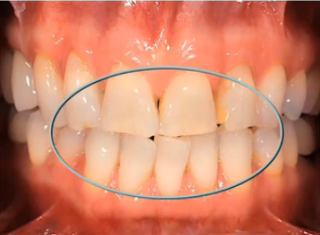
The patient in this picture is unhappy with how her teeth look. She came in with a high school photo that showed her teeth had shortened over time, and she wants to get them back to a more youthful appearance. The wear is confined to the anterior teeth, so we know there hasn’t been any change in vertical dimension. The problem is that when she bites, the incisors are end-to-end; there is no overjet. The question becomes: How do we lengthen her teeth to give her the appearance she wants?
What follows are the first four of eight steps I would go through to determine the answer.
Step 1: Central incisal edge.
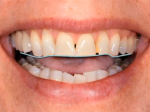
The starting point for determining tooth position is always the maxillary central incisors, just as it is in a denture. Until we know how to correct the central position, we don’t know where the remaining maxillary teeth should go. After evaluating her incisal edge position at rest and in a full smile, as well as in relation to the posterior occlusal plane, she would need a 1–1.5 mm addition to her tooth length incisally.
Step 2: Maxillary incisor inclination.
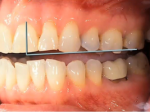
The next point of reference for the centrals is their labial lingual inclination. Remember, she has no overjet, and we want to lengthen her teeth 1–1.5 mm; the question is how to accomplish it. The options are to create an overjet or open her bite, but she has no wear on her posterior teeth, and she needs minimal posterior restorations. This means the ideal solution is to create an overjet. This can occur from proclining or moving the maxillary anteriors facially, or retracting or retroclining the mandibular anteriors. Step 2 lets us determine which changes are needed to the maxillary anteriors. In her case, a small amount of proclination may be beneficial, but it certainly won’t create the needed overjet, so a change will have to be made on the lower arch.
Step 3: Maxillary occlusal plane.
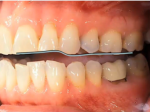
Following the determination of the central incisor position, it is possible to evaluate the position of the remaining maxillary teeth. We do this relative to our desired central incisor position. In this image, you can see initially that the centrals are apical to the occlusal plane of the posteriors. But if we lengthen the centrals 1–1.5 mm, the existing posterior position looks quite good.
Step 4: Determine ideal gingival levels.
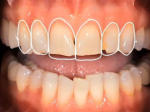
After determining the desired tooth positions relative to the incisal edges and cusp tips, the correct gingival levels can be determined. Remember that teeth often erupt as they wear; this is where we usually determine whether they did.
By now evaluating overall tooth length from our desired incisal edge position, we can determine whether the gingiva needs to be moved based on pleasing width-to-length ratios. If it doesn’t, it’s unlikely any eruption took place. If the tissue needs to be moved apically, some eruption has probably occurred. In this particular patient, the two centrals should ideally have the gingiva moved apically, indicating some eruption probably occurred as the teeth wore.
Read Part II for Steps 5–8, including the importance of mandibular incisor incisal edges.
FOUNDATIONS MEMBERSHIP
New Dentist?
This Program Is Just for You.
Spear’s Foundations membership is specifically for dentists in their first five years of practice. For less than you charge for one crown, get a full year of training that applies to your daily work, including guidance from trusted faculty and support from a community of peers.

By: Frank Spear
Date: December 4, 2012
Featured Digest articles
Insights and advice from Spear Faculty and industry experts