- Article
- Treatment Planning
Maxilla-First Treatment Planning
Jeffrey Rouse
•
March 28, 2022
What is maxilla-first treatment planning?
Maxilla-first treatment planning prioritizes evaluating and correcting the maxillary position before tooth movement or restorative work. This approach improves airway health, esthetics, and functional outcomes by addressing skeletal limitations rather than compensating for them dentally.
Why is overjet challenging in comprehensive treatment planning?
Overjet makes rehabilitation dentistry technically difficult. Excessive overjet can be problematic, but the solution is almost universally surgical. Too little overjet (end-to-end) is much more difficult to achieve.
Posteriorly, we can accept cross-bites or camouflage them by altering the crown form. Anteriorly, there are few restorative options to correct or camouflage. Unworn posterior teeth typically preclude altering vertical dimension, given the amount of dentistry required on virgin teeth. Pre-restorative orthodontics can improve the spatial relationship of the teeth. Orthodontic intrusion can align gingival margins, correct interarch discrepancies, and allow teeth to be restored.
The limitation is that we’re still working within the confines of the existing skeletal relationship. If the problem is greater than dent-occlusal and is skeletal, the damage to the patient may be significantly more impactful than poor dentofacial esthetics and altered function — it may be life-threatening. More importantly, it may be improved or cured by idealizing the skeleton.
Why should airway be evaluated in maxilla-first treatment planning?
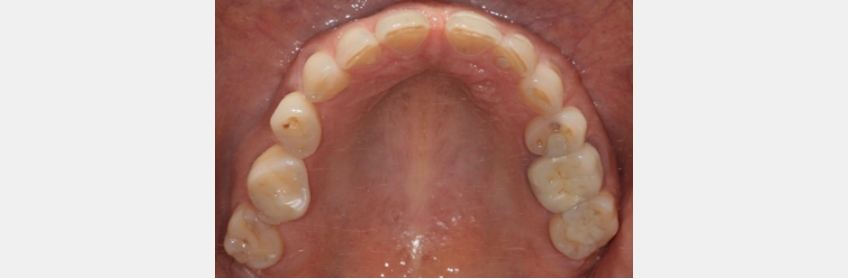
Facially Generated Treatment Planning (FGTP) is grounded in EFSB (Esthetics, Function, Structure, Biology), providing the foundation for a maxilla-first treatment planning approach. Esthetics leads comprehensive care planning by determining the incisal edge position of the central incisor. Once that position is properly established, we then determine how the lower arch will function against it. Finally, structural and biologic issues are addressed.
In 2016, Spear Education advanced the FGTP concept within a maxilla-first treatment planning framework, declaring that the airway should be examined before tooth positioning is initiated. Spear expands on this approach through the workshop, Treatment Planning With Confidence, and the Airway Prosthodontics: Just Do Dentistry seminar, where clinicians learn how to apply these principles in real-world cases. In many cases, the esthetic and functional positioning of teeth can be carried out in several ways. Some of those plans are more beneficial to the airway, and others are less so.
As part of maxilla-first treatment planning, for a patient with a hypoplastic maxilla and end-to-end tooth wear, expanding the maxilla surgically would routinely be more positive for the airway than extracting lower teeth and retracting the lower arch.
For example, for a patient with a hypoplastic maxilla and end-to-end tooth wear, surgically expanding the maxilla would typically be more beneficial for the airway than extracting lower teeth and retracting the lower arch. The esthetics of the smile and bite may appear the same, but technically, the extraction-and-retraction approach may worsen an already compromised airway. Beyond teeth, consider the long-term physiologic impact.
Focusing on maxilla-first treatment planning is not new
The idea of focusing on maxilla-first treatment planning as we begin is not new to Spear. FGTP uses a 2D template to position incisal edges and free gingival margins in the smiling face. The addition of airway makes the templates 3D, adding the sagittal and transverse planes.
The best example of this returns to the original principles taught by Dr. Frank Spear. He would say that all complex rehabilitations begin by determining the incisal edge position of the maxillary central incisors, just as with setting a denture. The simplicity of the technique allowed us to become comfortable with comprehensive case planning.
There was, however, a flaw in what Dr. Spear taught: Dentists never begin by putting the wax rim in the mouth, marking the midline, and setting the centrals. Instead, every dentist places the maxillary wax rim in the mouth and adjusts its vertical, anteroposterior, and transverse position before considering setting teeth.
A dentist would never consider leaving the wax deficient and adjust the number, size, or inclination of the teeth to fit within the confines of the wax. All practitioners would add wax or move the rims to idealize the position.
In analyzing the wax rim, the A/P and transverse dimensions represent the airway. People with narrow or deficient wax rims aren’t as healthy as those with ideal wax rims. Therefore, the evolution in FGTP is always to consider making the skeletal base or alveolar housing normal before considering “setting teeth.”
Maxillary growth and development are intramembranous. The mandible’s growth is endochondral. It has a pre-established pattern (e.g., Meckel’s cartilage in the mandible), whereas the maxilla is more like a papier-mache balloon. The skeleton is laid down around the form that you grow.
The elements that help the maxilla grow are force and pressure. Pressure is from nasal breathing. Force is from the tongue in the roof of the mouth during breathing, proper tongue function in swallowing, and utilization of the face muscles in eating, gnashing, and grinding.
Dysfunction of any or all these elements will alter craniofacial development. Common dysfunctions include large tonsils and adenoids that limit nasal breathing, and a tongue tie that prevents proper positioning and function.
While a functionally altered maxilla can alter the form of the developing maxilla, a poorly developed adult arch form can also alter function. A hypoplastic maxilla can alter a person’s breathing and affect their health. If the maxilla is normalized, their health may improve. Said another way, improving the esthetics and function of the maxilla may improve our patients’ overall health. This concept is used in case presentations to foster patients’ desire to seek comprehensive care.
What does research say about maxilla-first treatment planning and airway risk?
Here’s the proof. Recent studies in the otolaryngology literature are providing dentists with support for a new paradigm. The newest research shows that a narrow, highly vaulted maxilla in the premolar region increases the risk of having obstructive apnea.
In a separate study, it was determined that a narrow maxilla creates palatal or base tongue collapse. Further, the location of the narrowing is linked to different types of blockages: Molar narrowing creates different obstructive points than premolar narrowing. Lastly, if the maxilla is expanded, airway collapse is significantly reduced.
Why is maxilla-first treatment planning critical for long-term health outcomes?
In conclusion, within a maxilla-first treatment planning approach, given that the maxilla supports the nose and nasal function, idealizing its dimensions by positioning the teeth and bone in the ideal esthetic and functional positions can reduce nasal resistance and nasal valve collapse. Additionally, maxillary expansion in adults can improve oral volume for tongue function and airway clearance, increase muscle tone and tension in the velopharynx, and reduce collapse.
To go deeper into how airway, esthetics, and function integrate into predictable case outcomes, explore this guide to advanced dental treatment planning, where these principles are applied across complex restorative cases.
Frequently Asked Questions
References
- Vinha, P. P., Thuler, E. R., & de Mello-Filho, F. V. (2020). Effects of surgically assisted rapid maxillary expansion on the modification of the pharynx and hard palate and on obstructive sleep apnea, and their correlations. Journal of Cranio-Maxillofacial Surgery, 48(4), 339-348.
- Thuler, E., Rabelo, F. A., Yui, M., Tominaga, Q., dos Santos Jr, V., & Arap, S. S. (2021). Correlation between the transverse dimension of the maxilla, upper airway obstructive site, and OSA severity. Journal of Clinical Sleep Medicine, 17(7), 1465-1473.
Featured Digest articles
Insights and advice from Spear Faculty and industry experts