- Article
- Occlusion / Wear
Red Flag-Maxillary First Premolar Extraction for Orthodontics
Jim McKee
•
September 25, 2020
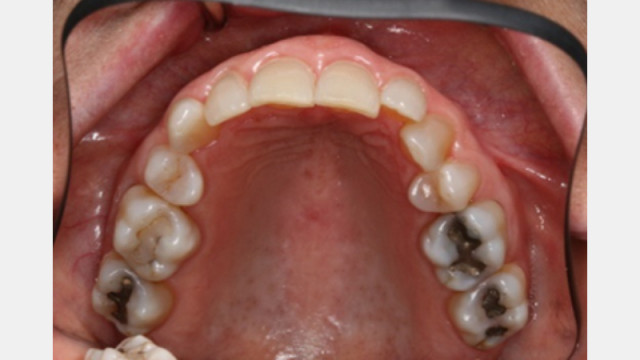
I had an unusual experience recently when I saw two new patients — incidentally, scheduled back-to-back — who both had three circumstances in common that resulted in a loss of airway volume and joint issues.
First, I saw a 45-year-old woman who presented with clicking and popping in her left jaw joint and reported that the problem was getting worse. She had an average pain of 6/10 with a worst pain of 7/10 in her right jaw joint and an average pain of 8/10 and a worst pain of 10/10 in her left joint.
She had modified her diet to avoid eating hard or chewy foods and said her joints started clicking when she was in her early 20s.
Her initial point of contact was 15/18 (27/37) in a fully seated condylar position and had a 2.0 mm anterior shift from a fully seated condylar position to maximum intercuspation. Her mandibular midline was 2.0 mm to the right of her maxillary midline in a fully seated condylar position. She opened 30.0 mm and said she used to click in both her right and left jaw joints.
She also reported mild muscle tenderness to palpation and had facial asymmetry to the right. She’s worn two different occlusal appliances and is currently using an anterior repositioning appliance, which is not helping her pain.
Her trauma history included two motor vehicle accidents at age 43 and surgical intubations at ages 40 and 44. Her anterior teeth were uncoupled by 2.0 mm in horizontal and vertical dimensions.
Next, I saw a 53-year-old woman, another new patient, who presented with a chief concern of clicking and pain in the left jaw joint. She told me the problem got worse about two years ago. She saw her ENT physician, who examined her ears and concluded they were not the source of the problem.
The patient explained it was difficult for her to chew food and she felt her bite did not fit together evenly. She also reported no pain in the right jaw joint but an average pain of 5/10 and a worse pain of 8/10 in her left joint. Like the first patient, this patient also modified her diet to avoid hard or chewy foods.
In this second case, the patient’s initial point of contact was 2/31 (17/47) in a fully seated condylar position, and she had a 3.0 mm anterior shift from that position to maximum intercuspation. Her mandibular midline was 2.0 mm to the right of her maxillary midline in a fully seated condylar position. She opened 37.0 mm and said she used to click in both her right and left jaw joints.
She reported minimal muscle tenderness to palpation and had a canted occlusal plane to the right. She’s worn one occlusal appliance, which didn’t help her pain. Her trauma history included falling out of a station wagon at age 11, a snowmobiling accident at age 21, and a dog hitting her chin at age 27. Her anterior teeth were uncoupled by 3.0 mm in a horizontal dimension.
Three Common Threads
Interestingly, both patients shared three essential facts. First, they had orthodontics from ages 12–14 to treat an overjet problem. Second, they both had audible crepitus in their right and left jaw joints.
Audible crepitus in a jaw joint usually means the disk is not covering the bone, and the noise (crepitus) is typically the result of bone-to-bone contact between the condyle and the joint socket.
The third common factor was that both patients had their maxillary first molars extracted when they had orthodontics.
To understand why the maxillary first molars were extracted for the orthodontic treatment for overjet, we must reverse-engineer the treatment plans for both patients. At the time, the thinking was that they had genetically small mandibles, so if the upper first premolars were extracted, it would be possible to retract the upper anterior teeth, thus reducing the overjet and creating a more normal anterior tooth relationship. However, we now know this is a flawed assumption, to think the overjet was the result of a genetically small mandible.
While genetics can cause a small mandible, the overwhelming majority of small mandibles are due to a structural alteration in the TMJ. Growth can be interrupted when the joints are injured in a growing patient (Figs. 1–4), resulting in a Class II occlusion with an overjet problem.
If occlusion is considered only at the tooth level without considering the condition of the TMJ, it’s easy to see why extracting the maxillary first premolars would make sense.


The problem now is once the TMJ is imaged with MRI and CBCT, it’s easy to understand the small mandible was not due to genetics, but rather due to incomplete growth of the mandible and the maxilla. The extractions were subtractive dentistry, which led to both esthetic and airway issues in both patients.
My advice is to always take a closer look at the jaw joints when patients present with maxillary first premolars extracted for orthodontic treatment. In most of these cases, there will be an undiagnosed joint issue that causes the overjet issue.
We can align with maxillary premolar and retractive orthodontics in the growing patient. Still, in most cases, the result will be a loss of airway volume and joint problems in the adult patient.
References
- Piper, M., & MD, D. (2020). Temporomandibular joint imaging. In Handbook of Research on Clinical Applications of Computerized Occlusal Analysis in Dental Medicine (pp. 582-697). IGI Global.
- Pirttiniemi, P., Peltomäki, T., Müller, L., & Luder, H. U. (2009). Abnormal mandibular growth and the condylar cartilage. The European Journal of Orthodontics, 31(1), 1-11.
- Manfredini, D., Segù, M., Arveda, N., Lombardo, L., Siciliani, G., Rossi, A., & Guarda-Nardini, L. (2016). Temporomandibular joint disorders in patients with different facial morphology. A systematic review of the literature. Journal of Oral and Maxillofacial Surgery, 74(1), 29-46.
SPEAR campus Workshops
Learn Hands-on From Faculty Who Still Practice
A few days at Spear Campus can change how you diagnose, plan, and present cases, not through more lectures, but through hands-on training led by faculty who treat patients every week. Work through real cases in small groups and leave with techniques you can use on your next patient.
Featured Digest articles
Insights and advice from Spear Faculty and industry experts