Positioning Maxillary Incisal Edges: Lip Mobility
In this article, we will look at perhaps the most significant factor affecting tooth position and the overall appearance of the smile: lip mobility.
Lip mobility is simply the amount the lip moves from where it sits at rest, to the highest position it moves to during a spontaneous smile. The key to understanding the role of lip mobility is to realize how the amount of tooth displayed at rest and the amount the lip moves combine to create the overall tooth display seen in a smile.
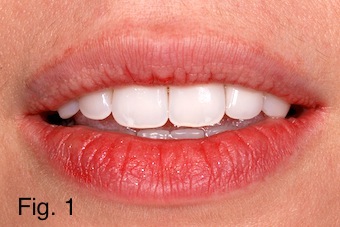
As an example, look at Figure 1. This young female shows 4.5mm of central incisor with her lip at rest. Assuming she has average (10.5 mm long) central incisors, it means there is 6 mm of central not visible under her lip. What her smile appears like is now dependent upon lip mobility — how far her lip moves.
- If her lip moves 6 mm, she will show the complete central incisor with no gingival display — what might be considered an ideal smile.
- On the other hand, if her lip moves 10 mm, her smile will show not just the entire central but also 4 mm of gingiva apical to the central — what some might consider a gummy smile.
- The other extreme would be if her lip moved only 3 mm; now she would only show 7.5mm of central, a less then full looking smile.
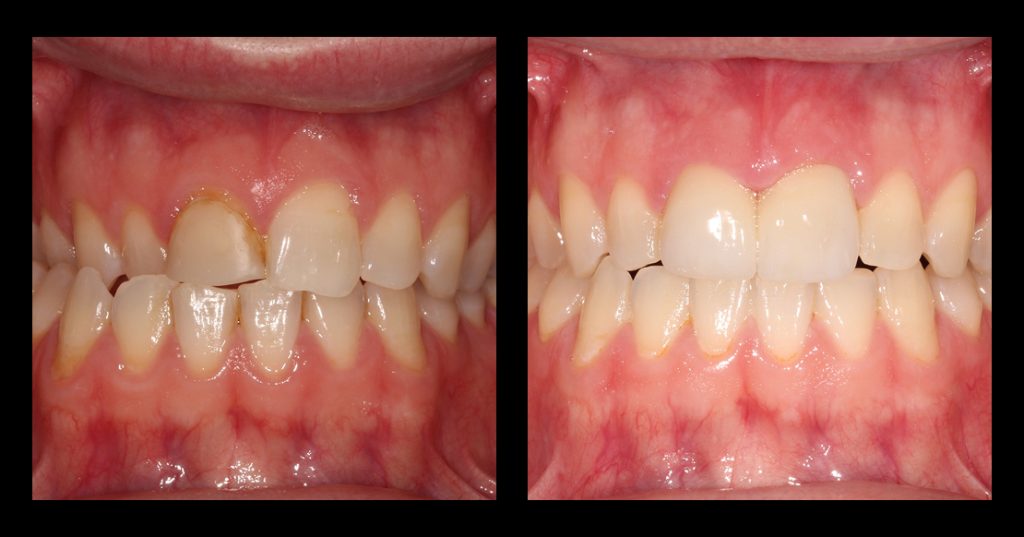
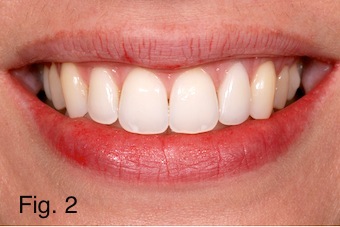
As we can see in Figure 2, her lip moves 6 mm, showing the complete central incisor and no visible gingiva. Understanding this relationship between lip mobility and the amount of central incisor displayed at rest is critical to understanding why we can’t use the amount of central displayed at rest as the sole determining factor for where to place the incisal edges of anterior teeth.
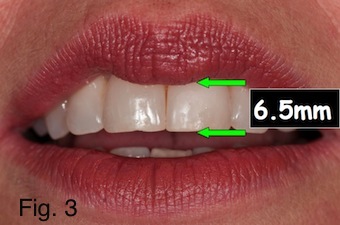
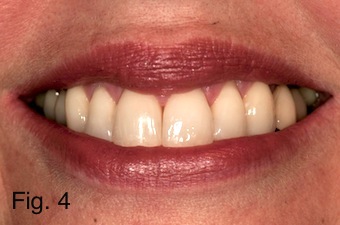
What this means is that the amount of lip mobility will ultimately affect not just where we position anterior teeth, but also the amount of central displayed at rest. The patient in Figure 3 is a perfect example; she shows 6.5 mm of central at rest, meaning there is probably 4 mm of central not visible. Assuming she has an average amount of lip mobility, 6–8 mm, her full smile should show the entire central and from 2–4 mm of gingiva as well, but as can be seen in Figure 4, her lip moves only4 mm, displaying the full central and no gingiva.
As a general rule, the lower the level of lip mobility, the more central will be visible at rest, assuming your goal is to show the entire central incisor in the smile. The opposite problem is, of course, a patient with a very high level of lip mobility. Assuming a goal for the smile of showing the entire central with minimal gingiva visible, and also at least 0.5–1 mm of incisal edge visible at rest, any patients with lip mobility levels above 10 mm will be problematic, unless you create a central longer then 10.5 mm.
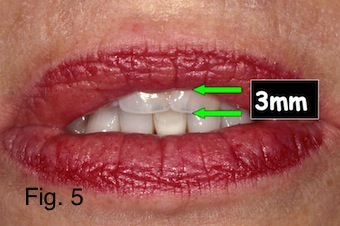
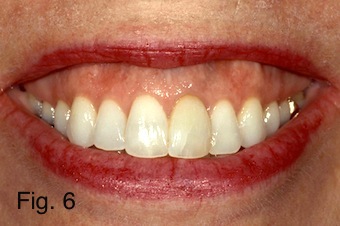
The patient in Figure 5 is an example of a patient with a relatively normal display at rest of 3 mm. Assuming a 10.5 mm long central, she would have 7 mm of central not visible under the lip; with a normal 6–8 mm of lip mobility during her smile, she would show most of the central, or the whole central and 1 mm of gingiva. As can be seen in Figure 6, she has 14 mm of lip mobility, meaning she shows the entire central and 7 mm of gingiva. She has what I would describe as a hypermobile lip.
In patients with hypermobile lips, there are typically two options for treatment,: Botox, which on average reduces lip mobility 3–5 mm but must be redone every three to six months, or lip repositioning surgery, which prevents the lip from elevating to its former level.
As a general rule, in patients with high levels of lip mobility, the amount of central showing at rest must be decreased as a way to keep a normal-sized central incisor and reduce the amount of gingival display, but not to the extent that no tooth is visible at rest. Learning to always measure lip mobility, from rest to a full smile, is a very useful tool in understanding where you might position the edges of the anterior teeth.
SPEAR NAVIGATOR
Transform how your practice runs by engaging the team through
coaching and training
A guided path to excellence through structured coaching and self-guided resources that will align your team, streamline processes and drive growth. Transform your practice by implementing Spear’s proven playbooks for developing and retaining a high-performing dental team.

By: Frank Spear
Date: October 15, 2013
Featured Digest articles
Insights and advice from Spear Faculty and industry experts