Taking Records for Day-to-Day Implant Restorations
One certainty in dentistry is that implants are becoming more common. A key reason for this is that when a tooth or multiple teeth are lost, implants often provide the best option for restoring our patients’ dentition as close as possible to ideal function.
Like restorations, there are choices in how we approach implant impressions, and while we may have personal preferences, there is no single solution perfect for every case. Although general rules apply to the various methods, we sometimes have to bend these rules, as I’ll demonstrate with a couple of sample cases where doing so was necessary.
In this article, I will break down the three most common options available:
- Physical impressions with a closed tray,
- Physical impressions with an open tray, and
- Digital scans.
While digital scans can be categorized into regular digital scans and those utilizing photogrammetry, I will focus solely on the former. Photogrammetry, while a fascinating and valuable method, requires additional equipment and, due to its specialized nature, warrants a separate discussion. My goal here is to focus on the day-to-day methods for recording implant impressions.
Closed tray impressions for implant restorations
Let’s start with closed tray impressions. First, you remove the healing abutment and place the closed tray impression coping onto the implant. Then, take the impression. After the impression material has set, remove the impression and take out the impression transfer. Finally, replace the healing abutment.
This method has its own set of pros and cons, outlined below.
| Pros | Cons |
| They are fast and straightforward, similar to taking a traditional tooth impression. You can often use a stock tray. If you need to retake the impression, you don’t require additional parts. | You or your lab must carefully place the impression transfer back into the impression; if done incorrectly, it can lead to a poor or unusable restoration. They are often best suited for more minor cases or single-unit restorations. The impression may become locked in the mouth or be challenging to remove if the implants are too divergent. |
Mastering open tray impressions for implants
Next, we have open tray impressions. For these impressions, you also start by removing the healing abutments, similar to the closed tray technique. However, the key difference is that the impression transfer pieces are much taller and need to extend above the tray (or at least be level with the tray’s edge). This design allows you to clear the impression material from the screw access, enabling you to unscrew and remove the impression tray once the material has fully set. There are several benefits and challenges associated with this method.
| Pros | Cons |
| There is little chance of locking in the impression tray due to divergent implants. The impression transfer is secured in the tray by the impression material once it has set, so you don’t need to worry about repositioning it accurately. | If a second impression is needed, you will either require extra impression transfers or need to cut the impression transfer out of the first impression. Without additional transfers, you must capture everything needed in a single impression, which can be difficult or sometimes impossible. This method typically takes more time than open tray impressions. It can be more challenging, as all transfers must have their screw access holes exposed and screws unscrewed to remove the impression from the mouth, which can be a stressful and challenging process. |
The benefits and challenges of digital scanning
Lastly, we have digital scanning. While digital scanning offers significant benefits, it also presents challenges, primarily related to the potential for introducing errors. As with the other methods, you start by removing the healing abutment, but instead of using impression copings, you place a scan body. Once the scan body is in place, you scan the entire area. It’s crucial to capture as much of the scan body as possible; missing significant portions can introduce errors. For implant-supported bridges, errors are more likely if you encounter edentulous areas with only soft tissue between implants. Ideally, you should keep the scan body of the implant you’re scanning in view while moving on to scan the next implant to minimize errors.
| Pros | Cons |
| Provides an excellent experience for the patient as there is no traditional impression. Fast and efficient. | Errors can be difficult to detect. Scanning for implant bridges is highly technique sensitive. |
Choosing between closed tray, open tray, and digital scans
So, what are my takeaways? The choice between a traditional closed tray, an open tray, and digital scanning depends on both the technical details of the case and the patient’s behavior. Generally, I prefer digital scanning because, after decades of experience, I find modern scanners to be fast, accurate, and user-friendly. Patients appreciate not having a traditional impression, and my lab prefers digital scans as well, which helps achieve the best results.
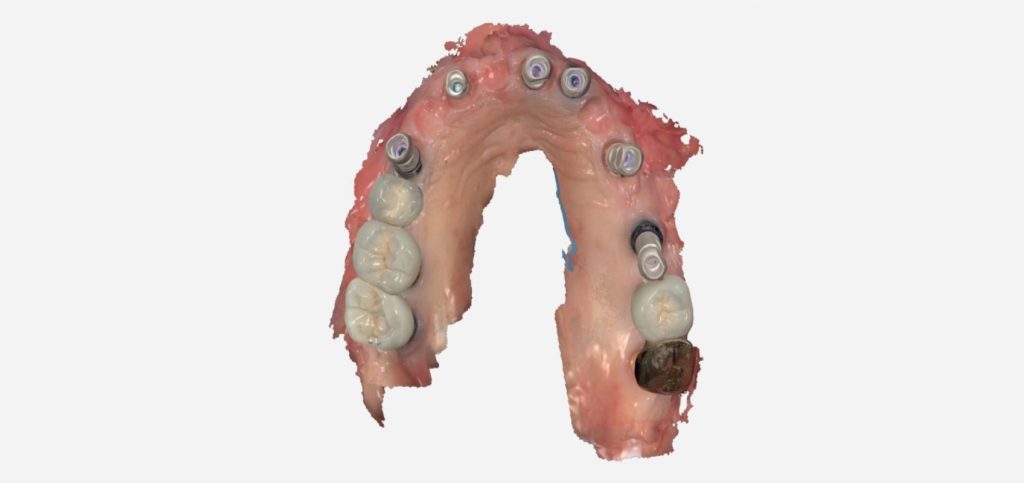
However, I tend to avoid digital scanning for large multi-unit or edentulous cases due to the higher risk of errors. I am becoming more comfortable with these cases, especially when I can keep hard structures, such as teeth or scan bodies, in the frame during the scan. For example, a recent case (Fig. 1) tested my comfort level, and although a traditional open tray impression could have been technically challenging, the patient’s previous negative experiences with impressions made digital scanning the only viable option.
Generally speaking, if I’m not comfortable scanning smaller cases with relatively parallel implants, I opt for closed tray impressions. For cases with significant divergence or large cases, I’ll use open tray impressions. However, if the implants are relatively parallel and closed tray impressions make more sense, I’ll stick with those.
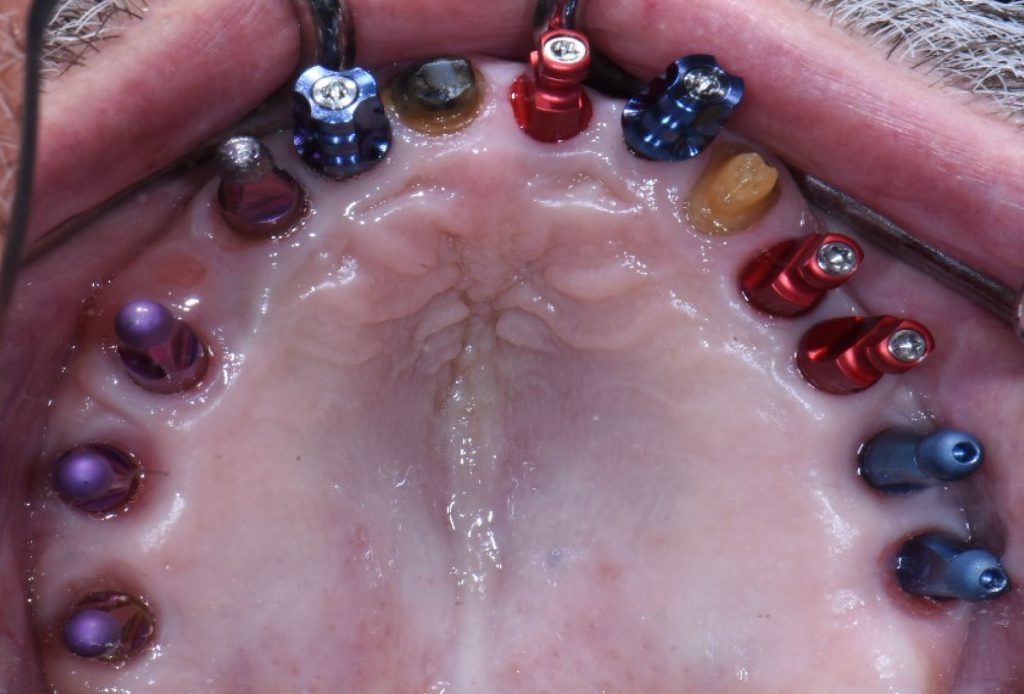
For example, in the case shown (Fig. 2), I’d never want to use an open tray here; finding every screw access would be a nightmare. By the time you’ve made enough openings, there’d be no tray left!
I hope you have found this article helpful, and it got you thinking! Want to talk about this more? Leave a comment or head over to Spear Talk!
SPEAR campus
Hands-On Learning in Spear Workshops
With enhanced safety and sterilization measures in place, the Spear Campus is now reopened for hands-on clinical CE workshops. As you consider a trip to Scottsdale, please visit our campus page for more details, including information on instructors, CE curricula and dates that will work for your schedule.

By: John Carson
Date: October 7, 2024
Featured Digest articles
Insights and advice from Spear Faculty and industry experts