- Article
- Practice Management
How to See the ‘New’ Patients in Your Dental Practice
Brent Bush
•
January 21, 2017

It’s no secret that new patients are the lifeblood of a growing and vibrant dental practice, and most of us utilize numerous strategies and resources to help those new people find us. Social media, external marketing, internal marketing, health fairs, volunteering our services … the list goes on and on.
While these strategies can and do provide channels for a new patient to see us, one of the best methods for adding exceptional new patients to your practice might be to see the ones who are already there.
You and your team could be the best resource for finding “new” patients, those who are already part of your existing patient base. When you can see your existing patients with new eyes, it creates an opportunity to see a “new” patient at every periodic examination.
See the ‘New’ in the Familiar
How do you gain new eyes? Learn to look at things differently. Get trained and redistribute staff duties to enhance your patients’ experience. Honestly analyze and claim ownership of your current office environment and determine potential changes. Take more photos and share them. Spend more time with your patients discussing what you have learned with them.
Everybody wants to attract the right kind of new patients, to change the practice by changing the people in it, by finding those who want what we have to offer. But the truth is that people are the same wherever you go. It’s you who has the potential to become different. When you see your patient, your team, and yourself differently, you will be able to create new and different experiences. These experiences have the potential to create engagement, which can lead to a more comprehensive view of health in general and of dental health as part of that. More comprehensive treatment does not mean crowns everywhere; it means we are addressing each patient’s specific needs and desires for creating a healthy mouth as part of a healthy body.
Transform Routine Visits Into Meaningful Conversations
You are the key and the catalyst to finding these “new” patients within your practice. Save some of that marketing money and invest it in yourself. Create a schedule that allows more time to talk with your patients. Allow your patients the opportunity to learn more about their teeth, mouth, and orofacial health. Give them a chance to understand and do what’s best for them, both now and for their future.
When you look at existing dental patients with new eyes, it will transform your practice and create many “new” patients whom you’ve already been seeing. What better place to start fostering transformation than within the practice you’ve worked so hard to establish?
Create Engagement That Builds Trust and Treatment Acceptance
The following is an example of a real world scenario that taught me how we can see with new eyes and help others see with us.
This is “Susan.” We all have Susan in our practice. She is a busy woman with a busy life, balancing work, her children, and her home. Five years ago, on her new patient health history form, she noted that she was taking no medications, was generally healthy except for a few headaches that she attributed to stress, and had undergone “some dental work” in the past. She had no stated dental concerns, although in discussion, she shared that her teeth were sensitive to cold drinks and she would like them to be whiter.
Susan had been coming to see me faithfully every six months for the past five years; routine cleanings for a routine patient. For the most part, she had no real complaints. She did still have that cold sensitivity but “not bad enough to bring it up, only because you asked.” When coaxed a bit, she did share that she occasionally had some “different” biting sensations on the lower right.
What do we do? Continue to see Susan every six months, monitor her sensitivity and tell her to call us if things get worse? Maybe this is the discussion if we are in a hurry, the schedule is backed up and the subgingival crown prep on #15 in Room 1 won’t stop bleeding.
But, what if we slowed down and took an occlusal photo for Susan to show her that lower right tooth?
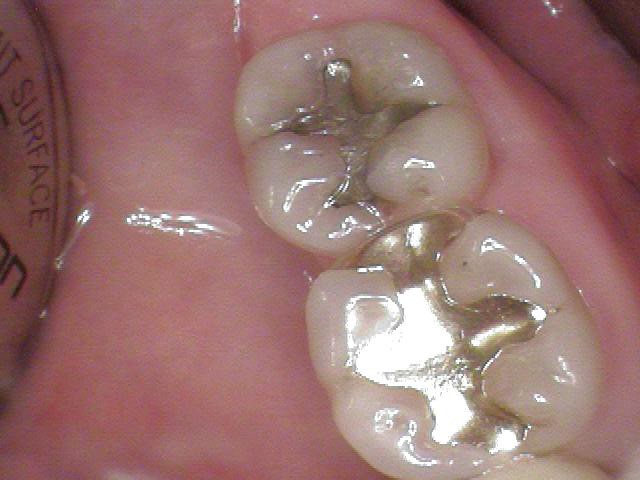
We can reassure Susan she has an old filling that looks to be in good service. We can note she has a few flat areas on the back teeth and there may be a bit of a craze line developing over the distal marginal ridge of the back tooth. We can also point out that the upper tooth that bites on this one has a crown.
This is when we explain tooth stress can cause flat spots, craze lines, cold sensitivity and, worse, broken teeth like the one on the upper.
By taking one photo, we have created an opportunity for Susan to become engaged with her own dental health. If Susan seems at least mildly engaged, we can take it a step further by taking a couple of more photos.
Now we can show Susan how her teeth come together when she bites.
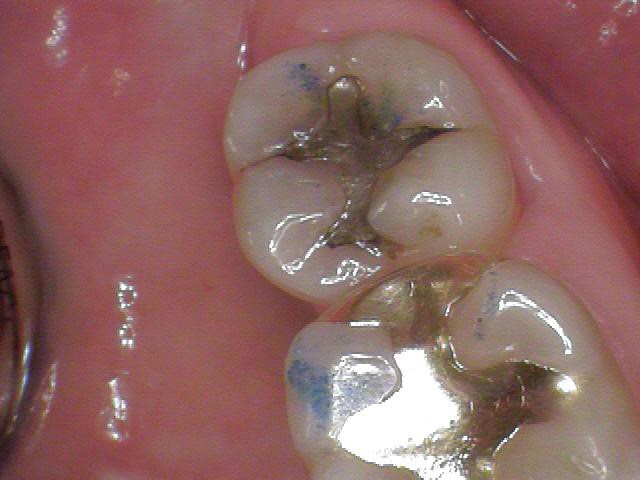
This is a good time to note that ideally we should bite only on certain areas of certain teeth when we close our mouth.
The next photo in the progression would be with articulating paper, having Susan slide her teeth back and forth.
Now is a great time for Susan to see how much her back teeth touch when she slides back and forth. This is when we note the blue marks are exactly where the flat spots are.
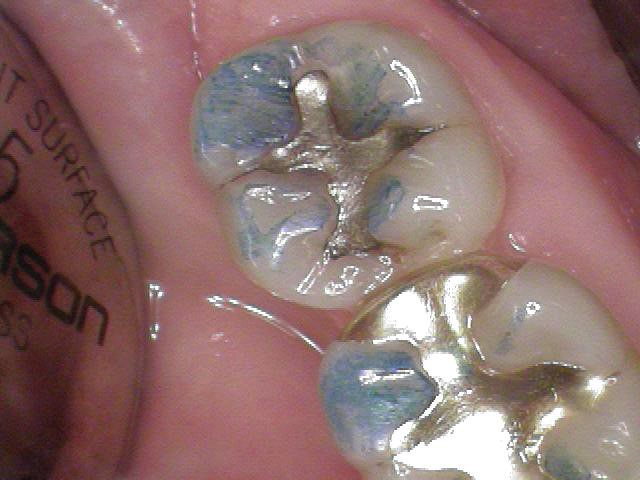
This is a good time to note how back teeth pressure may cause headaches and create tooth sensitivity.
Ultimately, we could even correlate why she has a crown on the opposing tooth.
Now we have created an experience for Susan. She has seen and heard far more in the last two minutes than she has in the past five years. We have taken the time to show her what is happening with her teeth and her bite. Now she can better understand the possible causes of some of her low-grade symptoms, such as sensitive teeth and headaches. This allows Susan to help us make appropriate decisions for her treatment as we move forward.
Perhaps it’s still a “wait-and-see” approach, or maybe a filling, a crown, equilibration, or studyingMany times the next question that comes out of a Susan’s mouth is, “What do we do about that?” The answer to this question will vary depending on your practice philosophy. Maybe it’s still a “wait-and-see” approach, maybe a filling, maybe a crown, maybe an equilibration, maybe study models.
The whole key is not the answer to the question, but that the patient asked the question in the first place. This is the question we want to hear. This is the question that lets us know we have just created a “new patient” from an existing patient.
SPEAR All access
One Membership, $555 More a Day
Practices on Spear All Access see a median daily production gain of $555, with a 9.9% median lift in hygiene production. That’s not from one course or one workshop. It comes from unlimited Spear and CDOCS workshops, the full online course library, role-based team training, practice analytics, and a dedicated Practice Growth Partner working with your team every month, all in one membership.
Featured Digest articles
Insights and advice from Spear Faculty and industry experts