- Article
- Practice Management
Essential OSHA Dental Cross-Contamination Standards
Spear Team
•
February 2, 2023

What every dental practice must do to meet OSHA and CDC requirements
OSHA dental compliance rests on a single principle: keep the workplace free of recognized hazards. Because OSHA has no dental-specific standard, practices must apply the General Duty Clause alongside CDC infection-control guidance, especially regarding cross-contamination. Cross-contamination remains one of the most common daily risks in a dental practice, and hygienists and other patient-facing staff regularly encounter hazards that could lead to outbreaks. Following the right guidance and keeping detailed logs helps minimize risk and protect your team.
What are OSHA dental cross-contamination standards?
OSHA does not have a specific standard for dental practices. Instead, dental offices are instructed to follow OSHA’s General Duty Clause and the subject-specific recommendations that apply to their work. The General Duty Clause requires every employer to provide a workplace free of recognized hazards likely to cause death or serious harm, and every employee to follow the safety standards and procedures that apply to their work. It’s the legal foundation for OSHA dental compliance, since no dental-specific OSHA standard exists. OSHA directs dental practices to CDC guidance on cross-contamination, which applies to the work dental teams do every day.
Cross-contamination occurs when a worker picks up a contaminant during daily activities and spreads it throughout the workplace, or even carries it home. In dental offices, the most common contaminant risks come from biological material. Patient saliva, mucus, blood, and other bodily fluids pose a consistent risk.
The strongest standard in place to prevent this kind of cross-contamination is the CDC’s 2003 Guidelines for Infection Control in Dental Health-Care Settings. It outlines nine categories of recommendations.
- Personal health elements: Create a written health program for your team covering exposure prevention, post-exposure management, immunizations, and work-related illnesses and restrictions.
- Bloodborne pathogen transmission prevention: Standard procedures for patient encounters and sharps management, plus workplace design and instrument use to minimize risk.
- Hand hygiene: Specific requirements for hand washing, glove use, disposal, and lotions to prevent dry skin, along with guidance on artificial fingernails and hand or nail jewelry that can interfere with gloves.
- Personal protective equipment: Recommended use of masks, protective eyewear and clothing, gloves, and face shields whenever the potential for contacting blood, saliva, OPIM, or mucous membranes exists, plus glove disposal guidance.
- Contact dermatitis and latex hypersensitivity: Screen all patients for sensitivity, keep latex-free emergency treatment kits on hand, and manage latex-sensitive patients in designated safe zones.
- Sterilization and disinfection of patient care items: Sterilizing FDA-cleared devices, decontaminating work areas and instrument processing areas, and sanitizing unwrapped instruments. This is one of the most extensive categories, and where practices should focus the bulk of training and written policy.
- Environmental infection control: Housekeeping, surface cleanliness, furnishings and carpets, cleaning blood or bodily-fluid spills, and using EPA-registered hospital disinfectants.
- Dental unit water lines, quality, and biofilm: Meeting EPA drinking-water standards, discharging water and air for 20 to 30 seconds after each patient on any device connected to the dental water system, and following boil-water advisory protocols when in effect.
- Special considerations: Dental handpieces, radiology, aseptic technique, single-use devices, preprocedural mouth rinses, oral surgical procedures, biopsy specimen and extracted-tooth handling, dental laboratories, lasers and surgical smoke, mycobacterium tuberculosis, Creutzfeldt-Jakob disease, and program evaluation.
These nine categories cover the primary areas that dental practices need to address to minimize the risk of cross-contamination. Guidance evolves. Outbreaks like COVID-19 are a reminder that infection control is a living framework, not a policy to file away and forget.
How should dental practices document cross-contamination prevention?
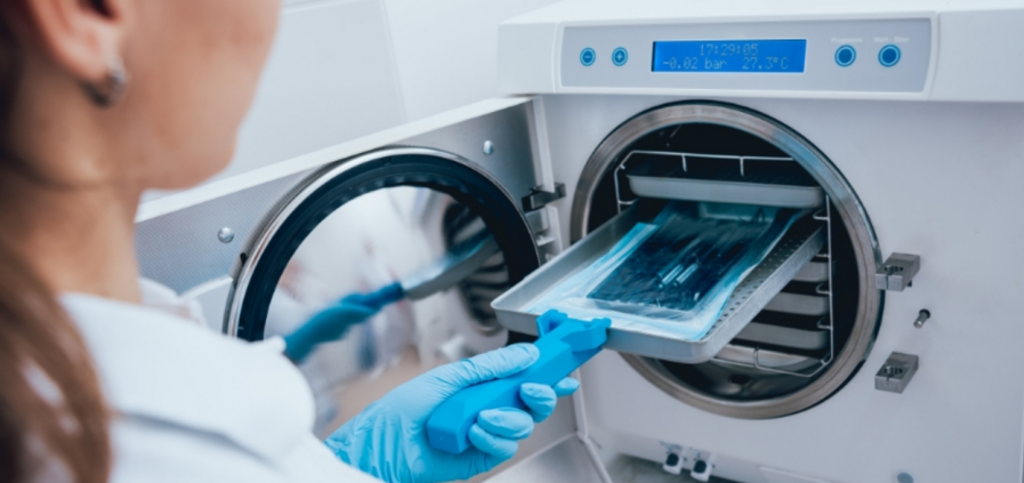
Regular logging ensures contaminated instruments or workspaces are not used again without proper sanitization. Team members should track when items are sterilized, for how long, and with what equipment. That makes it far easier to trace an issue if one occurs. For example, if a specific autoclave stops working at the end of the day, good records allow the practice to quickly identify which other equipment was affected, so the team can fix the problem and prevent further cross-contamination. Spear’s OSHA: Occupational Safety—Standards and Guidelines course walks through how to build these logs into the daily team workflow.
What are OSHA’s injury and illness reporting requirements for dental practices?
Cross-contamination logs are not the only records OSHA dental compliance requires.
Dental offices are considered partially exempt from many routine OSHA recordkeeping standards, but they must still report serious injuries or deaths within set timeframes. A work-related fatality must be reported within 8 hours. Inpatient hospitalization, amputation, or loss of an eye must be reported within 24 hours.
An online report submitted to OSHA should include:
- Establishment name
- Location of the accident
- Time of the accident
- Reportable event type (fatality, hospitalization, amputation, or loss of an eye)
- Number of employees involved
- Names of employees involved
- A description of the event
- Your contact person
Detailed reporting is generally required only for serious injuries, but logging every reported injury makes patterns easier to catch. It is also worth remembering that OSHA reporting is not the same as workers’ compensation. Workers’ compensation is the required financial protection you provide your team after a workplace injury, and it is governed by a separate agency with its own reporting requirements, which are usually more detailed than OSHA’s. See our related Digest article, 8 OSHA Safety Questions and Answers for Dental Offices, for a deeper walk-through of reporting scenarios.

How can dental teams build ongoing OSHA training into their practice?
Training is a large part of meeting OSHA dental cross-contamination standards. Your team needs to understand a wide range of policies and procedures to minimize risk to themselves and the public. Regular, structured training helps your team meet these standards, prevent outbreaks, and document and report an incident correctly if one occurs. Spear Online’s OSHA & HIPAA Compliance Essentials program, taught by dental practice safety and security consultant Mary Govoni, covers both areas in one place, so your team isn’t piecing training together from multiple sources.
OSHA dental compliance is not a single checklist. It is an ongoing discipline built on the General Duty Clause, CDC infection control guidance, accurate injury reporting, and consistent team training. Practices that build these habits into their daily routine protect their staff, their patients, and their bottom line.
Frequently Asked Questions
Spear Team Training
Train Your Entire Team, Not Just Yourself
Clinical confidence doesn’t stop with the doctor. Spear gives every role in your practice, hygiene, assistants, and front office, structured training built for their part of patient care, including the Hygiene Excellence Program. When the whole team learns from the same curriculum, your practice runs with more consistency, not just your chair.
Featured Digest articles
Insights and advice from Spear Faculty and industry experts