- Article
- Practice Management
Dental Practice Cash Flow: Effective Strategies for Every Season
Bill Harrigan
•
July 14, 2026

Managing dental practice cash flow is rarely about avoiding seasonal ups and downs altogether. Most practices experience predictable revenue fluctuations caused by patient schedules, school calendars, insurance benefits, doctor vacations, and other recurring patterns. The key is to plan ahead so that temporary slowdowns do not create unnecessary financial stress.
Dental practice owners know all too well the cyclical ups and downs of their business. Whether it’s the summer rush, the fall lull, or the race to spend FSA monies, every practice will experience ebbs and flows. It’s how you manage them that counts.
The key is being proactive with planning for the ups and downs.
Many practice owners don’t take the lows into account until they’re already upon them. If the business has already spent the extra cash flow earned during the highs, it adds a lot of stress during an already stressful time.
The good news is, with a little proactive planning, practice owners can smooth out the highs and lows, both financially and emotionally.
What patterns affect dental practice cash flow?
For many dentists, this might seem obvious. Of course, the summer is busy for pediatrics, and the back-to-school rush is crazy for general dentists.
Taking a closer look at two or three years’ worth of monthly revenue, however, can reveal unexpected patterns beyond the seasonal spikes.
As a financial advisor with Cain Watters and Associates (CWA), I had a three-doctor practice whose fall slow period was more severe than most. We dove into their numbers, but it wasn’t until one partner mentioned that the other two were “always off filling the deer feeders” that we realized the issue was the doctors leaving early on Fridays during hunting season.
Another factor that can contribute to revenue dips is a doctor or doctors taking an extended vacation. For example, a doctor taking a two-week vacation in April before the summer rush will affect cash flow in May, a slow period for many practices. Proactive planning for the temporary slowdown will ensure that the vacation and the return to work are a lot less stressful from a financial perspective.
To gauge where your practice ranks in terms of revenue, benchmarking reports using national averages are a great way to get an idea of how you compare. But having a CPA or planner do a deep dive into your financials is often the best way to really understand your production patterns.
Understanding where your revenue comes from is just as important as understanding when it fluctuates. Improving patient acceptance of recommended treatment can help create more consistent production throughout the year and support healthier cash flow. Learn more about strategies to improve dental case acceptance.
How do you calculate your dental practice’s break-even point?
Now that the cycles, both seasonal and self-imposed, are identified, it’s time to make a plan to level out the hills and valleys. Planning at least six months in advance can help ensure your finances are prepared.
The first rule of thumb is to know your break-even number.
The break-even point is the level of revenue at which total income equals total expenses, meaning the practice is neither losing nor making money. Everything earned beyond that point contributes to profit.
Understanding your break-even point is one of the most important steps toward improving dental practice profitability. While cash flow helps you manage day-to-day operations, long-term profitability depends on balancing revenue, overhead, production, and financial planning. Learn how these factors work together in our guide to dental practice profitability.
What is the dental practice break-even formula?
A CPA can help accurately identify your break-even point, but in general, the formula is:
Break-even = monthly costs ÷ profit margin %
Spear Online offers a course, Understanding Your Dental Practice’s Break-Even Point, created with CWA, to help dentists better understand the financial metrics that influence dental practice cash flow and long-term profitability.
Once the break-even point is identified, you have a benchmark to evaluate how to manage cash flow during your slow and busy months.
Another way to strengthen cash flow is by increasing treatment acceptance rather than relying solely on higher patient volume. Even small improvements in case acceptance can have a meaningful impact on production and profitability. Explore proven strategies for dental case acceptance.
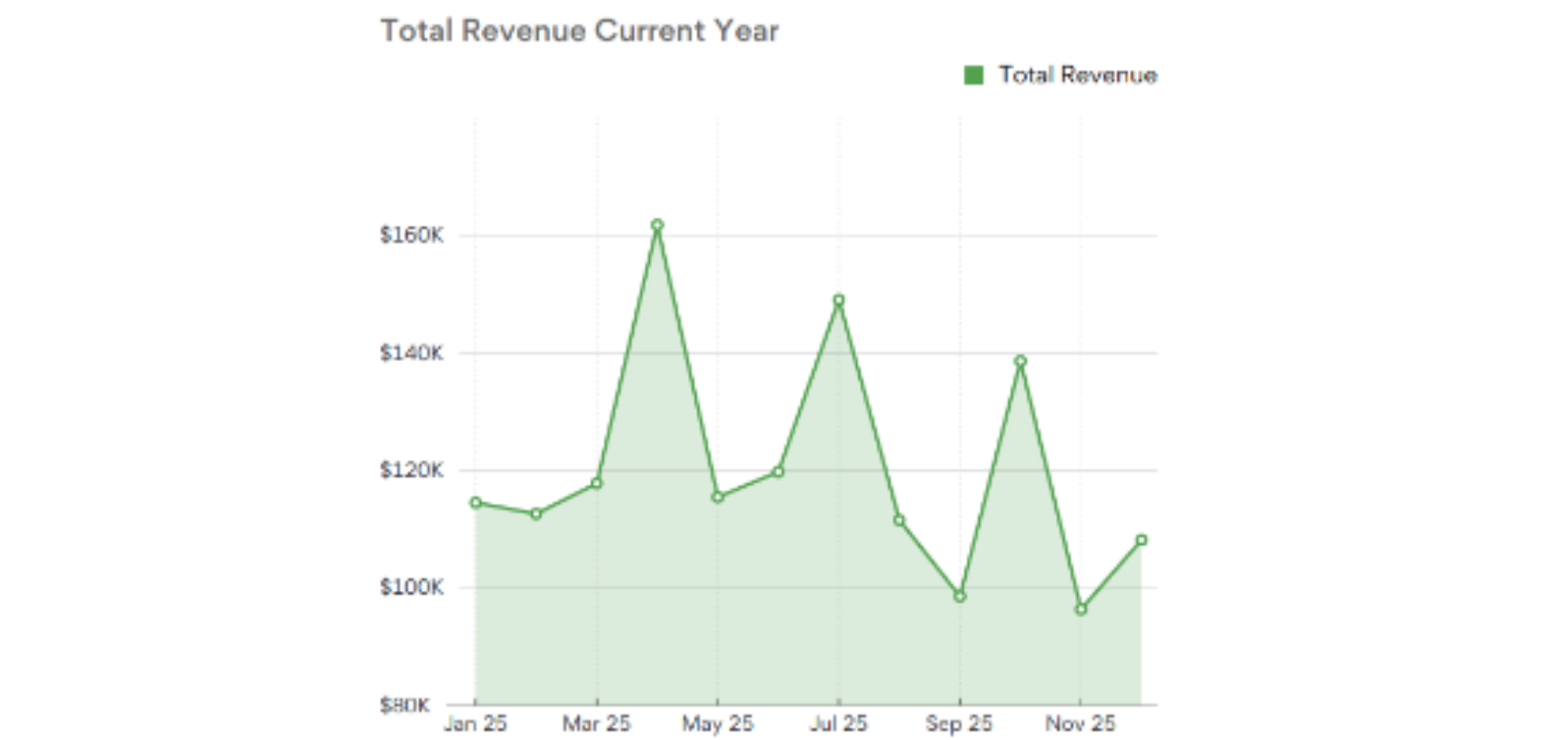
Referring back to the general practice revenue chart above, let’s assume the practice’s break-even point is $110,000. In September and November, the business will need to draw from the operating fund.
For a practice that’s not prepared for it, pulling money from company reserves can be a scary proposition. That’s why controlling spending during busy periods and keeping extra money in reserves is so important.
How should dentists manage surplus cash flow?
For many small business owners, extra cash in their operating account will soon be spent on the business. It might be a new coffee machine in the lobby, a larger owner distribution, or technology upgrades. While these might be worthwhile expenditures, earmarking a portion of the surplus each month to a business savings account is equally important.
Placing reserves in a separate account is important because it prevents owners from easily tapping the funds. During the slow months, moving a portion of the money back into operating capital allows owners to easily track how well the company weathered the slow period.
Well-managed dental practice cash flow allows doctors to do what they do best: care for patients, grow their practice, and sleep well knowing that the business is on solid ground.

Why does dental practice cash flow planning matter?
Dental practice cash flow planning is not about eliminating every revenue dip. It’s about preparing for the natural highs and lows of practice ownership.
Healthy cash flow is essential, but it’s only one component of dental practice profitability. Lasting financial success also depends on managing overhead, improving case acceptance, increasing production efficiency, and building systems that support sustainable growth. For a broader look at how these elements work together, explore Spear’s complete guide to dental practice profitability.
By understanding your production patterns, calculating your break-even point, and building reserves during stronger months, you can create greater financial stability throughout the year. Spear Online and CWA offer educational resources designed to simplify key practice management concepts and help dentists make more confident financial decisions.
Cain Watters is a Registered Investment Advisor. Cain Watters conducts business only in states where it is properly registered or exempt from registration requirements. Registration is not an endorsement of the firm by securities regulators and does not mean the advisor has achieved a specific level of skill or ability. Re-quest Form ADV Part 2A for a complete description of Cain Watters investment advisory services. Diversification does not ensure a profit and may not protect against loss in declining markets. Past performance is not an indicator of future results.
Frequently Asked Questions
Spear Team Training
Train Your Entire Team, Not Just Yourself
Clinical confidence doesn’t stop with the doctor. Spear gives every role in your practice, hygiene, assistants, and front office, structured training built for their part of patient care, including the Hygiene Excellence Program. When the whole team learns from the same curriculum, your practice runs with more consistency, not just your chair.
Featured Digest articles
Insights and advice from Spear Faculty and industry experts