- Article
- Spear Member Stories
Dental Associate Ramp Time: How DSOs Accelerate Growth
Spear Team
•
June 25, 2026

What happens when a new associate joins a practice with no clinical playbook and no institutional knowledge to fall back on?
When Dr. Allison Besse completed her residency at Yale and joined a Select Dental Management practice in Vermont, she arrived as the primary clinician almost immediately. The retiring dentist was transitioning out, the support staff was already in place, and Dr. Besse was, in her own words, “essentially starting alone.”
Dental associate ramp time is the period between a new dentist joining a practice and reaching consistent, full-capacity clinical production. For DSOs, reducing dental associate ramp time is critical because it directly affects revenue, clinical consistency, patient experience, and long-term retention.
For any DSO, that scenario carries real operational risk. A new associate navigating an unfamiliar patient base without structured clinical development support is slower to produce, more likely to experience early burnout, and harder to retain.
Dr. Traci Portnoff, Director of Doctor Development at Select Dental Management, had seen this problem firsthand across their 38-practice Northeast network. “I quickly realized we didn’t have the resources or infrastructure to onboard and fully support dentists coming out of school and hold them to a standard of care,” she said. “It made sense to lean into Spear and ask, ‘Can you help us with the resources for these newer doctors?’”
Select Dental Management addressed that gap by deploying Spear’s Associate Foundations Program as a structured development framework from day one. Dr. Besse’s trajectory became one of the clearest cases for what that investment can produce.

How can DSOs reduce dental associate ramp time without overwhelming new associates?
The concern most DSO operators have about continuing education programs is the same concern Dr. Besse had as a new clinician: more obligations layered on top of an already demanding ramp-up period.
Dr. Portnoff designed Dr. Besse’s onboarding specifically to avoid that trap. The structure started with a Spear Study Club, which created a low-barrier entry point, before expanding into Spear Online educational content and in-person workshops as Dr. Besse’s footing solidified.
“Dr. Portnoff set up the program with Spear in such a manageable way that it wasn’t a burden,” Dr. Besse said.
That framing matters for DSO leaders evaluating implementation risk. An education program that feels punitive or overwhelming to new associates will see low adoption and poor ROI.
Dr. Portnoff was deliberate about that dynamic. According to Dr. Besse, the Spear program “Expanded my knowledge, and I felt like I could go back Monday morning and put things into practice. I felt like I was getting better with each course.”
The result for Dr. Besse was not passive consumption. She returned from Spear’s Restorative Design workshop and applied what she had learned immediately. “Day one back from Arizona, I was already implementing, and I felt like I had a much better skill set to offer my patients,” she said.
For DSOs, that kind of time-to-application is what shortens dental associate ramp time in practice. Every week, a new associate who isn’t performing at full capacity is a week of production left on the table.
According to the ADA Health Policy Institute, DSO affiliation and large-group practice models continue to expand as organizations seek scalable systems that support clinician performance and organizational growth. As competition for talent increases, many organizations are realizing that recruiting associates is only the first step. The greater challenge is helping new clinicians become productive and aligned with organizational standards as quickly as possible.
Effective DSO clinical operations depend on more than efficient scheduling and standardized workflows. They also require systems that help associates become productive, confident clinicians faster. That development infrastructure is a foundational component of clinical growth in DSOs because it strengthens provider performance, improves clinical consistency across locations, and helps organizations scale without sacrificing quality of care.
How does reducing dental associate ramp time improve clinical consistency?
One of the harder operational problems in multi-location dentistry is clinical consistency. Reducing dental associate ramp time becomes more difficult when clinicians across locations follow different treatment philosophies and communication approaches.
When different providers work different days with different staff, the patient experience fragments. Treatment recommendations vary. Communication breaks down. The practice’s reputation and its conversion rate from hygiene to restorative care suffer.
Dr. Besse used Spear Online to address this directly by extending access to her entire team rather than just herself.
“It’s been really helpful to have my team access the online content,” she said. “If I watch a video and think it would be helpful for someone on my team, I can assign it to them, whether they’re in administration, insurance, or a clinical role. It allows us to grow together and maintain a more consistent clinical standard.”
Dr. Portnoff observed the same dynamic across her cohort. “The online learning library has really been a huge tool not only for clinicians but also for our operations teams,” she said.
The downstream effect for Dr. Besse was measurable in the consistency of patient communication. “Consistent language is a huge part of co-discovery. My hygienists and I are aligned, so patients aren’t hearing different messages from different providers. We’re using the same evidence-based approach and terminology, which helps patients better understand their treatment options.”
“Business aspects just are not covered in school. Spear really helped me understand how to have more complete conversations with patients while seeing the bigger picture clinically.” — Dr. Allison Besse
For DSOs managing teams across multiple sites, this is a scalable model. A shared Spear Online account serves as a common clinical language system, reducing variability not only in clinical decisions but also in how those decisions are communicated to patients, which directly affects case acceptance.
What production impact can shorter dental associate ramp time create?
When asked directly about production outcomes, Dr. Besse did not hedge. For DSO leaders, one of the clearest indicators of successful dental associate ramp time is measurable growth in provider production and treatment acceptance.
Over the course of the structured onboarding, Dr. Besse’s production grew by 18% to 22%, results that closely align with those observed by Dr. Portnoff across the broader associate cohort.
“Production per day is as clean as it gets because that’s dollars,” Dr. Portnoff said. “On average, production per day is up 12% in the past three months. My doctors, who are in their second year of the program, are showing a 20% increase in daily production. That’s approximately $1,000 more per doctor per day. That’s not small dollars when you add it up over time.”
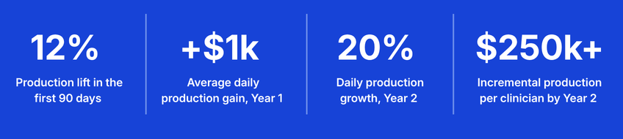
Critically, Dr. Portnoff benchmarks those results against a control group of similar providers not in the program. “When I compare apples to apples, the productivity line for my pilot group is going straight up, and the control group is pretty stagnant,” she said.
For Dr. Besse, the production gains stemmed from a specific clinical shift the Restorative Design workshop produced. Before Spear, she described the dominant treatment pattern she had inherited: a binary choice between a filling and a full-coverage crown. After the workshop, she began identifying onlay candidates and other intermediate restorations that extend tooth longevity and open new treatment planning conversations.
“Instead of looking at isolated teeth, I started seeing the whole picture: how function, long-term health, and comprehensive treatment planning all connect. Day one back, I was already implementing,” Dr. Besse said about Spear’s Restorative Design workshop.
“My overall case acceptance has definitely increased,” she said. “I’m able to be more efficient, more predictable, use better workflows so that there are fewer redos, less sensitivity, and a better overall experience for the patients.”
In a multi-location DSO, improvements like those, reduced remakes, faster appointment cycles, and higher case conversion, compound across your provider base. The unit economics shift when you stop treating dental associate ramp time as a variable beyond your control.
How does dental associate ramp time affect retention and leadership development?
DSOs lose significant value when early-career associates disengage. The cost of recruiting, credentialing, and ramping a replacement is high. The reputational cost with a loyal patient panel is higher.
Early-career development programs are one of the most defensible retention investments a DSO can make. In fact, many organizations are discovering that doctor development in DSOs is a critical driver of retention, leadership growth, and long-term clinical consistency. Dr. Portnoff made that case directly to Select Dental Management’s leadership.
“Our doctors who invest in their education are our top producers,” Dr. Portnoff said. “Our talent acquisition team always wants to be included in my communication and tied in with all the Spear resources because they feel like it’s a huge selling point, not only to recruit new doctors but also to retain talent.”
For Dr. Besse, the development experience delivered something beyond clinical skill: a shift in professional identity that made her a more effective practice leader earlier than she expected.
“The breadth of knowledge I have access to, and I’m encouraged to participate and explore, has allowed me to be a much younger practice leader than I had ever expected,” Dr. Besse said. “I’m more productive and feel like I’m truly making a difference for those who entrust their care with me.”
She also named something that rarely surfaces in CE conversations: the confidence that comes from knowing where to go when you don’t have the answer.
“Coming up on challenging cases, I think I would feel very alone and isolated and overwhelmed by not knowing,” she said. “But now, even if I don’t know something, I know where I can go for help. And that alone, having the confidence to find it and the resources to do so, makes everything more streamlined.”
That is not a soft benefit for DSO operators. An associate who stays, performs confidently, communicates clearly with patients, and mentors their team creates enterprise value. An associate who feels isolated and unsupported leaves, or stays and underperforms.
Why is dental associate ramp time a strategic DSO growth metric?
Dr. Besse’s experience at Select Dental Management points to a model that addresses several DSO operational priorities simultaneously: faster associate ramp-up, clinical consistency across the team, improved case acceptance and production, and meaningful early-career retention.
Her 18% to 22% production growth reflects what’s possible when dental associate ramp time is treated as a structured process rather than an open-ended variable. Dr. Portnoff’s cohort-level data, a 12% average production-per-day increase across new participants and 20% among second-year providers, gives model numbers executives can take into a budget conversation.
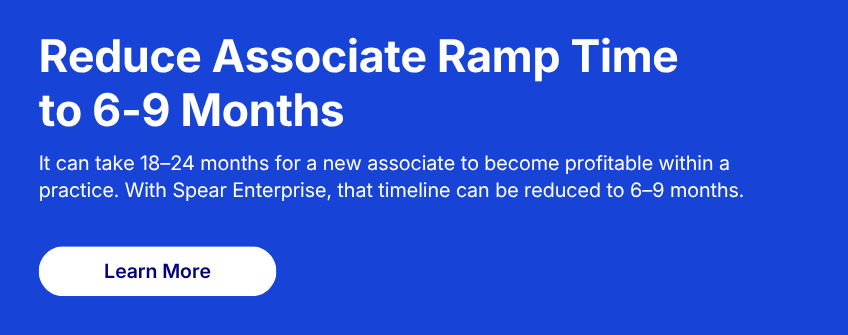
None of that happened by accident. It happened because Dr. Portnoff designed an intentional onboarding structure using Spear as the foundation, not as an optional perk, but as a defined development pathway with accountability built in.
The question for any DSO evaluating Spear is not whether clinician development matters. It’s whether you have a structured system to deliver it at scale, or whether you’re leaving that outcome to chance.
The bottom line on dental associate ramp time
Dental associate ramp time influences far more than onboarding success. It affects production, clinical consistency, case acceptance, retention, and long-term organizational growth.
Select Dental Management’s experience demonstrates that when dental associate ramp time is supported by a structured clinical development pathway, associates become productive faster and organizations see measurable business results.
For DSOs seeking scalable growth, investing in clinician development is one of the most effective ways to improve both operational performance and patient outcomes.
Frequently Asked Questions
Spear Enterprise
Standardize Clinical Quality Across Every Location
When every doctor ramps up differently, production and clinical consistency vary from practice to practice. Spear provides your organization with structured onboarding and role-based training pathways, so new doctors reach full productivity faster, and every location upholds the same clinical standard.
The result: up to $2,200 per day in increased doctor production.
Featured Digest articles
Insights and advice from Spear Faculty and industry experts