- Article
- |
- Spear Member Stories
5 Steps Behind a Dental Practice Transformation
What does a real dental practice transformation look like inside a working practice? Not in theory or a CE brochure, but in a practice navigating staffing turnover, technology investments, and rising clinical expectations.
For Dr. Donald Anderson, the transformation did not come from a single course or technology. It unfolded through a series of deliberate changes that reshaped how his practice operated, how he diagnosed patient care, and how he collaborated with other clinicians.
Over time, five key shifts defined the transformation:
- Stabilizing operations after disruption
- Structuring continuing education
- Redefining clinical philosophy
- Integrating airway diagnosis
- Building interdisciplinary collaboration.
Together, those changes turned disruption into a clear path toward comprehensive care.
What does a dental practice transformation involve?
A dental practice transformation occurs when clinical education, diagnostic philosophy, and practice operations align to support more comprehensive care.
For Dr. Anderson, that shift began after a period of significant disruption. Following rapid staff attrition and major technology investments, he began restructuring how his practice operated and how CE translated into everyday treatment planning.
What followed was not a quick fix but a deliberate reset that connected decades of learning into a cohesive clinical approach.
Step 1: Operational reset after disruption
The first step in Dr. Anderson’s transformation came during one of the most challenging periods of his career.
“In 2022, I purchased my first digital scanner, mill, and 3D printer with the mindset of keeping up with the digital direction dentistry was going,” he said. “While I was on that educational journey, I lost six employees in seven months.”
The sudden loss of staff created operational and financial strain. To stabilize the practice, Dr. Anderson reassessed how the practice functioned, including staffing and insurance participation.
Working with Navigator Practice Growth Partner Vanessa White, he ultimately dropped several insurance plans to align operations with the realities of staffing and patient care.
What began as a disruption became the catalyst for rebuilding the practice more intentionally.
Step 2: Structured CE
Once operations stabilized, Dr. Anderson shifted how he approached CE.
Rather than taking isolated courses, he began sequencing learning more intentionally.
Through Spear Navigator, he worked with White to move through the Spear Core Curriculum with clear clinical objectives tied directly to implementation within the practice.
“I decided to rebuild my practice with the Spear philosophy in mind.”
This change transformed CE from a collection of ideas into a practical roadmap for clinical decision-making.
“I decided to rebuild my practice with the Spear philosophy in mind,” he said.
Step 3: A new clinical philosophy
A pivotal moment came through faculty engagement and mentorship.
At Spear Summit 2024, Dr. Anderson met Spear Resident Faculty member Dr. Jeff Bonk. Over the following months, conversations with Spear Faculty helped him connect decades of learning into a more cohesive diagnostic framework.
“Drs. Kinzer, Rouse, Dichter, and Winter provided such great experiences and knowledge. Prosthodontics restored my joy in this field in all honesty.”
Faculty engagement accelerated the flywheel. “Dr. Dichter asked if I would be interested in helping him with his occlusion workshop in 2024,” Dr. Anderson remembers. “And with Dr. Bonk’s infectious enthusiasm, I decided to look into becoming a Spear Visiting Faculty member.”
“For the first time in 30 years, I started to link all the things that I had learned along the way as a general dentist,” he said. “I started the transformation of thinking like a prosthodontist.”
This shift changed how cases were evaluated, how treatment plans were sequenced, and how long-term outcomes were considered.
Step 4: Airway-centered diagnosis
Airway education introduced another major shift in Dr. Anderson’s diagnostic approach.
Having lived with sleep apnea since 2002, the topic carried both professional and personal significance.
After attending Dr. Jeff Rouse’s airway seminar and workshop in early 2025, Dr. Anderson implemented the Seattle Protocol in his practice.
Within three months, 12 patients were already undergoing airway-focused diagnostic and treatment planning.
“Once you see airway, you can’t unsee it,” he said.
The change reshaped how underlying causes of dental problems, such as bruxism and fractured teeth, were evaluated and discussed with patients.
Step 5: Interdisciplinary collaboration
The final step in the dental practice transformation involved expanding learning beyond the practice.
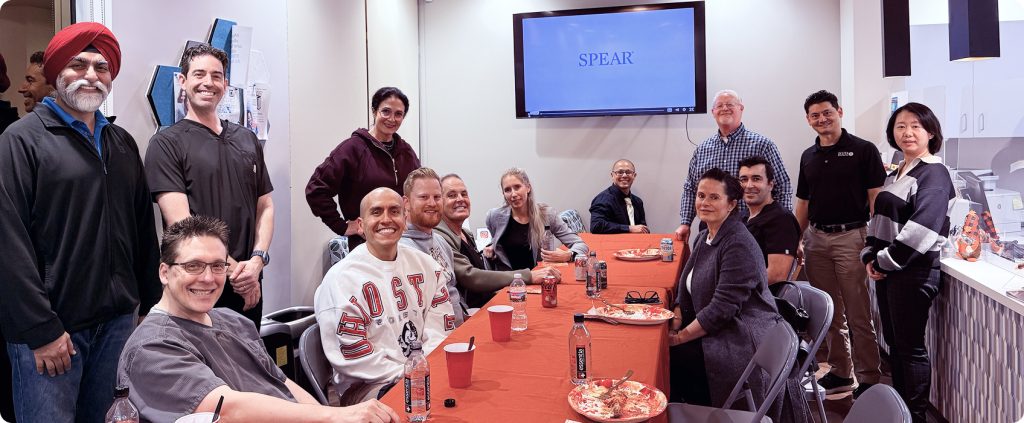
Inspired by Spear Summit 2025, and with support from Spear Study Club Specialist Trish True, Dr. Anderson launched an airway–prosthodontic-focused study club to bring together multiple specialties around collaborative case planning. The group now includes:
- Oral and maxillofacial surgery (OMFS)
- Orthodontists
- Pedodontists
- TMD/orofacial pain specialists
- Endodontists
- General dentists
The study club created a shared diagnostic language and stronger referral relationships.
“We’re constantly learning what each other can do, and that changes how we plan cases together,” Dr. Anderson said.
What does a successful dental practice transformation look like?
A true dental practice transformation rarely comes from a single course or technology. Instead, it develops when operational strategy, clinical education, and collaborative networks evolve together.
For Dr. Anderson, those five steps created a practice built around structured learning, airway-informed diagnosis, and interdisciplinary care. Looking back, the results still surprise him.
“If anyone had asked me in 2022 if I thought I would be anywhere near where I am now, I would have probably thought they were crazy,” he said.
For practice owners navigating staffing disruption, technology investments, and rising clinical complexity, Dr. Anderson’s experience highlights a simple truth:
A dental practice transformation rarely happens all at once. It happens step by step when education, diagnosis, and collaboration begin to align.
Frequently Asked Questions
SPEAR All access
An Integrated System for Practice Growth
Spear All Access is an integrated growth system for dentists who want to build a high-performing practice. Attend any Spear or CDOCS workshop, access all our online courses and chairside tools, and work with a Practice Growth Partner to implement the system.

By: Spear Team
Date: March 24, 2026
Featured Digest articles
Insights and advice from Spear Faculty and industry experts