- Article
- Practice Team
Patient First Impressions: Setting the Tone for Long-Term Relationships
Adam McWethy
•
March 19, 2021

One of my first transformative experiences with the dental community occurred long before I was involved with Spear. This experience occurred in my late 20s and significantly impacted several initiatives I have been involved in at Spear — most significantly the development of our patient education platform.
This was an interesting time in my life, as I was facing challenges in both my personal and professional worlds. I had recently quit my job to start a company in a new industry, and I was in the process of finalizing a divorce. Needless to say, this was a stressful period in my life, and at the time, my oral health had taken a back seat to the obstacles in front of me.
I knew that this was a problem, but it was not until my gums would bleed if you pushed on them with a finger that I really grasped the depth of my issues. So I went to a dentist.
I was nervous because I knew that I had neglected my oral health for too long. We began the exam by taking probing depths, and about halfway through, they stopped and got the doctor. He entered, looked at my mouth, and asked me, “Do you want to keep your teeth?”
No Patient Wants to Feel Shamed for Discomfort With Oral Health
At this point, I had not considered edentulism to be a possibility. He then left the room and returned with a photocopy of a dental textbook with a condition highlighted. As I read the description of acute necrotizing ulcerative gingivitis, he then let me know that he was not going to prescribe my antibiotics because he didn’t want me to feel better and not do anything to fix the issue.
The doctor then let me know I had a choice to make about if I was going to keep my teeth. Then the appointment ended.
This was unsettling, and I left with no intention of coming back. That experience kept me out of a dental office for another 3-4 months. One day, I drove by a dental practice near my home and decided I was going to do something about it. I walked in with no appointment and told the front desk person what I had been told and that I needed to do something about it.
She listened, empathized, and congratulated me on being willing to walk in. She then talked me through what I would need to do and what it would likely cost, and then set my first appointment. In the end, I went through with treatment, became a regular patient, and referred other patients into the practice.
The Make-Or-Break Nature of First Visits to the Dental Practice
In retrospect this is an extreme example of how a first appointment can be a practice-builder or a practice-killer.
The thing to understand is that there is some compelling science behind the power of a first impression and its ability to color or affect the perception of ambiguous information in the future.
Confirmation bias is the tendency to interpret, favor and recall information that supports one’s prior beliefs or values. It turns out that humans have a very hard time being objective when it comes to anything.
We view the world through the lens of our life experience and that colors what we perceive and remember. This effect is magnified in stressful or emotional situations.
This is all part of our need as humans to arrange the world into patterns that make sense so we can better predict potential outcomes helping us to avoid harm. So what does this mean for your practice?
When a new patient comes into the practice, you do not know their impression of dentistry or through what lens they are interpreting this first experience.
If you can create a positive first impression, you will set up a better lens through which they view your office. This will help set the tone for all interactions down the road, setting up meaningful conversations when you present needed treatment.
The next question becomes, how do we do this? No one sets out to make a bad first impression on patients, so where do practices go wrong?
Planning, Practice, and Proof
As a team, you might consider how you address three key elements of handling new patients.
Planning
Great patient interactions do not happen by accident. Yes, you can get lucky and hire people who inherently do the right thing every time.
However, if you want to be successful, you will need to plan out your new patient experience in detail. From your website to the first call to the appointment, you should envision what your ideal experience looks like and what to do when something goes wrong.
How do you answer a price shopping patient? How do you align scheduling for new patients so that you minimize the risk of them waiting?
What are the hand-offs like for each team member? Planning in detail will ensure an exceptional patient experience.
Practice
Once you have a plan in place the next step is to practice it. You cannot expect your team to read a piece of paper and then be able to execute at a high level.
Take the time to role-play interactions so the team can take the plan you have given them and find ways to incorporate their own personal style while continuing to execute the experience you designed.
This can seem overwhelming, but try taking it one item at a time. Focus on the first phone call, and once it is consistent, then move on to hand-offs. Change is never easy, so taking it one step at a time and building a supportive environment will set the team up for success.
Proof
This is the step that most practices and many non-dental businesses tend to skimp on. Once you have your new systems in place, what are you doing to ensure they are working and the team continues to follow through after the initial implementation phase?
Let me answer this in two parts:
First, you should have a follow-up plan. Review call recordings not as a “gotcha” but as a coaching opportunity. Set aside times every month or two to review new patients and brainstorm what worked and what did not.
Second, help the team to troubleshoot difficult situations as a group to better solve them in the future. This makes it a part of the culture of the practice and ensures that things like this become part of what you do, rather than episodic events.
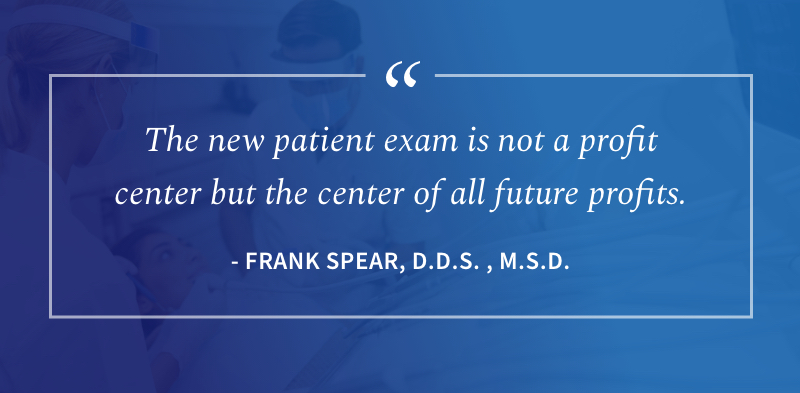
I know it seems like a lot, but I go back to something Dr. Spear has been saying for years: “The new patient exam is not a profit center but the center of all future profits.”
Investing in patient experience will affect people’s perceptions of the practice. This ultimately leads to increased case acceptance and referrals, which are the lifeblood of every practice.
SPEAR All access
One Membership, $555 More a Day
Practices on Spear All Access see a median daily production gain of $555, with a 9.9% median lift in hygiene production. That’s not from one course or one workshop. It comes from unlimited Spear and CDOCS workshops, the full online course library, role-based team training, practice analytics, and a dedicated Practice Growth Partner working with your team every month, all in one membership.
Featured Digest articles
Insights and advice from Spear Faculty and industry experts