Closing the Class II Restoration Box, Part 1: Common Problems
The Class II restoration is the most frequently performed procedure in general dental practice in the U.S.1, accounting for significant practice revenue. In recent years, there has been a significant shift away from silver amalgam as a restorative material and a move towards direct resin composite, which offers advantages such as:
- Natural esthetics, for a more pleasing appearance.
- Mercury-free material, solving the issues of waste management.
- Adhesive quality, therefore restoring the structural integrity of the tooth and sealing exposed dentinal tubules.
However, placement of dental composite in a Class II box is technically demanding for the clinician, and, as a result of common problems and challenges, many Class II restorations are doomed to failure before the patient even leaves the office.
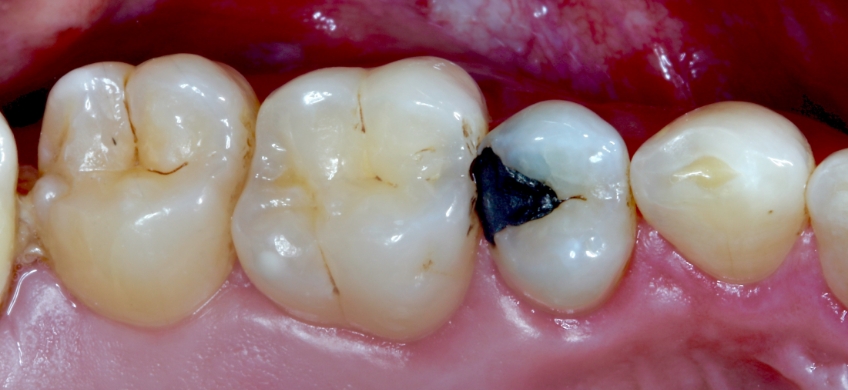

This three-part series will explore common failure modalities and solutions to overcome them. We’ll start with this article, which examines the most common problems, focusing on one area in particular.
The common issues encountered post-operatively after placement of Class II direct composite restorations include sensitivity and white lines at the margins (there are several reasons for this, one of which is poor quality preparation and conditioning of the enamel substrate; this is explored in a recent Spear Digest article), poor quality or non-existent contact points, overhangs at the gingival margin or axial wall, and voids at the interface of the composite resin and margin.
Another factor is failure to control polymerization shrinkage stress in a high C-Factor cavity, which is worth examining at greater length.
Outcomes of Polymerization Shrinkage Stress in Class II Restorations
Polymerization of dental composite resin is always accompanied by marked volumetric shrinkage of 2% to 6%2. This is due to the conversion of monomer molecules into a polymer network, which results in a bulk contraction3.
The composite resin shrinkage strain is translated to stress within the Class II restoration since the composite resin is confined within the cavity geometry. When polymerization stress is generated, there are multiple outcomes, most commonly:
- Deformation of the tooth structure leading to enamel fracture, cracked cusps, and cuspal movement4.
- Failure of the interface between the composite resin and the tooth (adhesive failure). Often, the resin is pulled away from the least bonded surface (resin separation concept), and a marginal gap is formed. This margin is typically the gingival box floor since the enamel in this location is often extremely thin or lacking. Clinically, the outcome is white lines and sensitivity in the short term; often, this will progress to secondary caries in the mid-to-long term.

The impact of polymerization shrinkage stress depends on the size of the cavity: larger Class II restorations have lower stress levels in the restoration and larger stresses within the tooth structure; therefore, the tooth tends to fracture. In contrast, in smaller restorations, the tooth is more resistant to polymerization shrinkage stress, and the stress concentrates within the restoration, resulting in marginal breakdown.
Factors Influencing Polymerization Shrinkage Stress
So why does polymerization shrinkage stress occur? Four main factors contribute to the process:
1. Filler Content
Composite resin is a polymer matrix with filler particles. Shrinkage is directly related to the proportion of polymer matrix within the resin: the more monomer converts to polymer, the higher the degree of contraction. Conversely, the space occupied by the filler remains unchanged during polymerization. Therefore, the higher the filler content, the less stress is generated5.
2. Degree of Conversion
Small increases in the degree of conversion result in substantial stress increases. However, this should be balanced by the fact that higher conversion improves mechanical properties6.
3. Elastic Modulus
The polymerization stress is correlated with the rate of gain of Elastic Modulus (stiffness) of the composite resin. The stiffest material generates the most stress. Further, the Elastic Modulus increases as the polymerization reaction proceeds7. This is expressed in Hooke’s Law: Polymerization Stress=Volumetric Shrinkage X Elastic Modulus. In other words, the higher the composite’s elastic modulus and volumetric shrinkage, the higher the stress generated.
4. C-Factor Ratio
The concept of C-Factor (or Cavity Configuration Factor) was initially described by Feilzer, De Gee, and Davidson in 1987.8
A high C-Factor ratio gives a high propensity toward the generation of higher stresses within the restoration. For example, a direct resin veneer has only one bonded surface (the facial) and one free surface, giving it a low C-Factor. In this restoration, polymerization contraction is restricted in only one direction, therefore allowing the composite to flow freely in the early rigid stage, reducing stress and allowing development of high bond strengths. In large masses, therefore, management of polymerization stress is a simple matter, and resin masses can usually be placed and polymerized without concern.
In contrast, the Class II proximal box has four bonded surfaces (the gingival floor, the facial axial wall, the lingual axial wall, and the pulpal wall) and only two unbonded surfaces. Here, the cavity walls hinder the contraction stress in three directions, and there is less potential for stress release by flow, which results in higher polymerization stress during polymerization. This requires more complex management strategies, which we will address in the following articles about Class II restorations.
References
- Feilzer, A. J., De Gee, A. J., & Davidson, C. L. (1987). Setting stress in composite resin in relation to configuration of the restoration. Journal of Dental Research, 66(11), 1636-1639.
- “American Dental Association Procedure Recap Report.” Chicago, IL: American Dental Association; 2006.
- Bowen, R. L., Nemoto, K., & Rapson, J. E. (1983). Adhesive bonding of various materials to hard tooth tissues: forces developing in composite materials during hardening. The Journal of the American Dental Association, 106(4), 475-477.
- Patel, M. P., Braden, M., & Davy, K. W. M. (1987). Polymerization shrinkage of methacrylate esters. Biomaterials, 8(1), 53-56.
- Meredith, N., & Setchell, D. J. (1997). In vitro measurement of cuspal strain and displacement in composite restored teeth. Journal of Dentistry, 25(3-4), 331-337.
- Condon, J. R., & Ferracane, J. L. (2000). Assessing the effect of composite formulation on polymerization stress. The Journal of the American Dental Association, 131(4), 497-503.
- Braga, R. R., & Ferracane, J. L. (2002). Contraction stress related to degree of conversion and reaction kinetics. Journal of Dental Research, 81(2), 114-118.
- Braem, M., Davidson, C. L., Vanherle, G., Van Doren, V., & Lambrechts, P. (1987). The relationship between test methodology and elastic behavior of composites. Journal of Dental Research, 66(5), 1036-1039.
SPEAR campus Workshops
Step Into a Place Built for Mastery
Step away from the noise of practice and into focused, immersive training that changes how you think, diagnose, and lead.

By: Jason Smithson
Date: February 21, 2023
Featured Digest articles
Insights and advice from Spear Faculty and industry experts