Bonding Systems and Adhesive Strategy, Part 3
Editor’s note: Adhesion to tooth structure (dentin and enamel) is a routine procedure in general dental practice in which the grail is predictability and longevity. In this series of articles for Spear Digest, Resident Faculty member Dr. Jason Smithson will cover the past, present, and future of bonding systems and adhesive strategy.
- Part 1: The challenges of bonding to enamel and dentin, and the history of enamel bonding.
- Part 2: Current strategies for bonding to enamel: substrate preparation.
- Part 3: Current bonding strategy recommendations.
Etch-and-rinse and self-etch are the two bonding strategies available in the current dental marketplace. ER and SA agents differ significantly in how they react with dental hard tissue (enamel and dentin).
Etch-and-rinse bonding agents
Also known as fourth- and fifth-generation bonding agents, ER products originated from Buonocore’s research on acid etching.
Components of ER bonding agents
- An acid etchant (phosphoric acid).
- A primer that contains hydrophilic monomers carried by a solvent (water, acetone, or ethanol) and bridges the gap between the hydrophobic resin and the wet dentin.
- An adhesive — the resin that stabilizes the primer layer. (In some products, the primer and adhesive are combined in a single bottle.)
Phosphoric acid is applied to both the enamel and dentin, which results in demineralization (the removal of inorganic components). On enamel, an etch pattern is created; on dentin, the smear layer is removed, exposing the collagen fibrils.
The bonding agent is then applied, which forms a mechanical interlock with the etched enamel and a hybrid layer on the dentin.
ER systems typically generate high bond strengths; however, they are technique-sensitive and are easily affected by contaminants such as saliva, crevicular fluid, and blood.1

Self-etch bonding agents
SE adhesives — also known as sixth-, seventh-, and eighth-generation bonding agents — contain acidic functional monomers such as 10-MDP, which form hydrolytically stable, strong, and durable bonds with the hydroxyapatite in both dentin and enamel. The advantage of self-etching systems is reduced technique sensitivity (and therefore a lower incidence of postoperative sensitivity).
Components of SE bonding agents
- An acidic primer, which removes some of the smear layer and chemically bonds to calcium in both enamel and dentin.
- An adhesive resin that stabilizes the primer layer.
Some products combine both items into a single bottle, but two-bottle systems with separate primer and adhesive have demonstrated higher bond strengths on dentin than ER systems.3
The selective-enamel etching technique has been shown to increase bond strengths and reduce marginal staining on enamel when used with SE adhesives.2 In this technique, only the enamel margin — not dentin — is etched with phosphoric acid for 15 seconds, then rinsed and dried. A self-etching bonding agent is then applied to both dentin and enamel; this technique confers the advantages of both ER and SE bonding agents.
Three main components of dental adhesive systems
Matrix resins
Matrix resins form the backbone of the adhesive system, creating the structural framework that binds the filler particles and transfers forces/stresses within the body of the adhesive layer.
These resins can be categorized as either base or diluting monomers.
- The type of base monomer determines the physical characteristics of the adhesive, such as flexural strength and compressive strength. Common base monomers are Bis-GMA and UDMA, both of which have excellent mechanical properties. However, they are highly viscous and require modification with diluting monomers to enhance flow and improve handling.4
- Diluting monomers improve adhesive handling properties by reducing viscosity. They also optimize the degree of polymerization/conversion, which reduces polymerization shrinkage and improves overall bond strength. Examples are TEGMA and HEMA.
Initiators
Initiators catalyze the conversion of monomers into polymers, helping to convert the adhesive into a solid-state matrix that links the composite resin to dentin and enamel.
The initiator may be chemical-cure, light-cure, or dual-cure; each type has different properties for degree of conversion, mechanical strength, and esthetic stability. (Older adhesive resins often experienced a color shift over time.)
Chemical initiators, also known as auto-cure or self-cure initiators, contain both a catalyst (typically benzoyl peroxide) and an activator (an amine). Their advantage is the ability to polymerize in areas that light can’t penetrate, such as beneath crowns or adhesive cementation of posts. Their downsides are significantly reduced working time and color instability.5
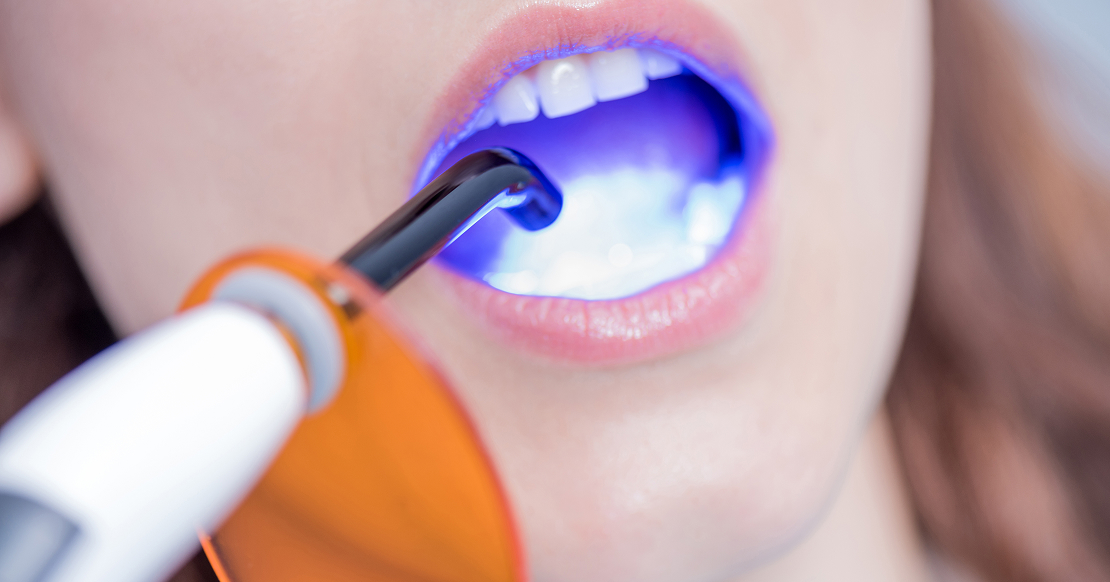
Light-cure initiators are activated by blue light to produce free radicals that initiate polymerization. One widely used photo initiator is camphorquinone (CQ), used in combination with an amine co-initiator. This works at a wavelength of around 465 nm.6
From a practical standpoint, clinicians should ensure that the output wavelength of their polymerization lamp corresponds to the working wavelength of the initiator(s) in both the bonding agent and the composite resin they’re using. This is particularly important when using modern LED-type polymerization lamps, which often operate within very narrow wavelengths.
One problem with CQ is its yellowish color, which commonly affects esthetics. It is often combined with Ivocerin or Lucerin TPO to improve esthetics, enhance depth of cure, and broaden the absorption spectrum.7 Phenylpropanedione can also be substituted for or used alongside CQ to reduce yellowing.8
Dual-cure bonding agents are both chemical- and light-initiated; they’re used in much the same way as chemical initiators in areas where light penetration is limited.9 These initiators are typically CQ with a tertiary amine (light-curing component), in combination with benzoyl peroxide with an aromatic sulfonic acid salt (chemical-cure component).10
Fillers
Filler particles are designed to:
- Increase mechanical properties such as compressive strength and wear resistance.
- Reduce polymerization shrinkage. (Filler particles don’t change dimension when the monomer is polymerized, so increasing the percentage of filler helps reduce polymerization shrinkage.)
- Increase radioopacity.
Traditionally, silanized silica fillers are used, but these are at risk of hydrolytic degradation in the mouth.11
References
- Dey, S., Shenoy, A., Kundapur, S. S., Das, M., Gunwal, M., & Bhattacharya, R. (2016). Evaluation of the effect of different contaminants on the shear bond strength of a two-step self-etch adhesive system, one-step, self-etch adhesive system and a total-etch adhesive system. Journal of International Oral Health, 8(3), 378-384.
- Van Meerbeek, B., Yoshihara, K., Van Landuyt, K., Yoshida, Y., & Peumans, M. (2020). From Buonocore’s pioneering acid-etch technique to self-adhering restoratives. A status perspective of rapidly advancing dental adhesive technology. Journal of Adhesive Dentistry, 22(1), 7-34.
- Valsan, D., Bhaskaran, S., Mathew, J., Hari, K., & Joy, J. (2023). Comparative Evaluation of the Bonding Efficacy of Multimode Adhesive, Two-Step Self-Etch Adhesive, and a Total-Etch System to Pulpal Floor Dentin–An In vitro Study. Contemporary Clinical Dentistry, 14(2), 104-108.
- Sideridou, I. D., & Achilias, D. S. (2005). Elution study of unreacted Bis‐GMA, TEGDMA, UDMA, and Bis‐EMA from light‐cured dental resins and resin composites using HPLC. Journal of Biomedical Materials Research Part B: Applied Biomaterials: An Official Journal of The Society for Biomaterials, The Japanese Society for Biomaterials, and The Australian Society for Biomaterials and the Korean Society for Biomaterials, 74(1), 617-626.
- Sideridou, I. D., Karabela, M. M., & Vouvoudi, E. C. (2008). Dynamic thermomechanical properties and sorption characteristics of two commercial light cured dental resin composites. Dental Materials, 24(6), 737-743.
- Asmussen, E., & Peutzfeldt, A. (1998). Influence of UEDMA, BisGMA and TEGDMA on selected mechanical properties of experimental resin composites. Dental Materials, 14(1), 51-56.
- Van Landuyt, K. L., Snauwaert, J., De Munck, J., Peumans, M., Yoshida, Y., Poitevin, A., … & Van Meerbeek, B. (2007). Systematic review of the chemical composition of contemporary dental adhesives. Biomaterials, 28(26), 3757-3785.
- Dressano, D., Salvador, M. V., Oliveira, M. T., Marchi, G. M., Fronza, B. M., Hadis, M., … & Lima, A. F. (2020). Chemistry of novel and contemporary resin-based dental adhesives. Journal of the Mechanical Behavior of Biomedical Materials, 110, 103875.
- Ferracane, J. L., Stansbury, J. W., & Burke, F. J. T. (2011). Self‐adhesive resin cements–chemistry, properties and clinical considerations. Journal of Oral Rehabilitation, 38(4), 295-314.
- Moszner, N., & Salz, U. (2001). New developments of polymeric dental composites. Progress in Polymer Science, 26(4), 535-576.
- Elshereksi, N. W., Ghazali, M., Muchtar, A., & Azhari, C. H. (2017). Review of titanate coupling agents and their application for dental composite fabrication. Dental Materials Journal, 36(5), 539-552.
SPEAR campus
Hands-On Learning in Spear Workshops
With enhanced safety and sterilization measures in place, the Spear Campus is now reopened for hands-on clinical CE workshops. As you consider a trip to Scottsdale, please visit our campus page for more details, including information on instructors, CE curricula and dates that will work for your schedule.

By: Jason Smithson
Date: December 16, 2025
Featured Digest articles
Insights and advice from Spear Faculty and industry experts