All About Articaine Hydrochloride and Dentistry
What is Articaine Hydrochloride?
Articaine Hydrochloride, commonly marketed as “Septocaine” in the United States and known simply as Articaine, is a local anesthetic first introduced to dentistry in the 1970s and FDA-approved for use in the US in 2000. This local anesthetic differs from the other commonly used local anesthetics in dentistry because it contains a thiophene group.
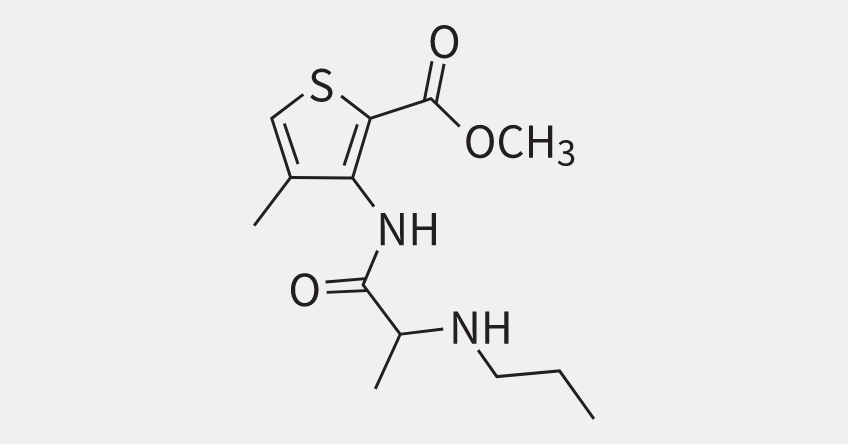
The thiophene group or ring causes articaine to be more lipid soluble than other commonly used local anesthetics in dentistry. This enables articaine to pass through bone and the nerve membrane more efficiently than other local anesthetics. With the ability to diffuse through bone, dentists can use articaine for local infiltration injections, even in the mandible, with higher success than other anesthetics commonly used in dentistry.
Pharmacology of Articaine Hydrochloride
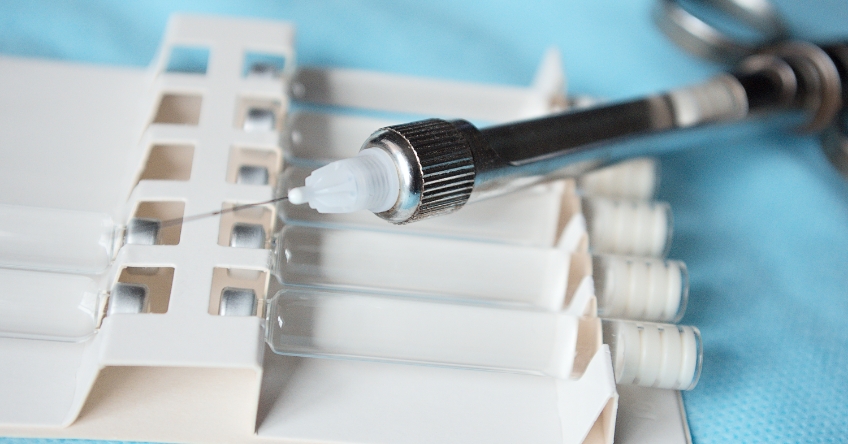
Articaine hydrochloride is commonly distributed in a four percent solution at 1:100,000 or 1:200,000 epinephrine concentration. In the U.S.A., it is routinely provided in a 1.7mL carpule for dental usage.
It has a maximum dose of 7 mg/kg, or 3.2 mg/lb, and can be administered to adult and pediatric patients over four years of age. Its duration ranges from approximately 45 minutes to 75 minutes and has a half-life of 20 minutes.5
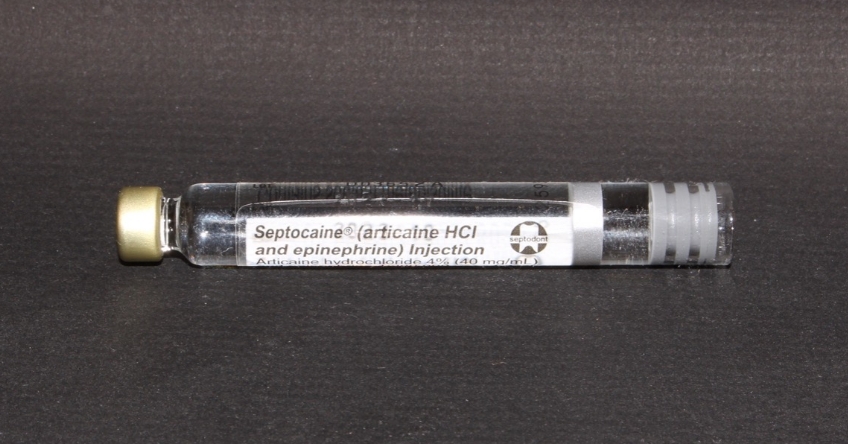
Studies have shown no significant difference in the duration or half-life between 1:100,000 and 1:200,000 epinephrine concentrations of articaine. The only notable advantage of the 1:100,000 epinephrine formulation is that the higher concentration of epinephrine may help control bleeding, especially during surgical procedures.
Articaine Controversy
Multiple studies have shown the effectiveness of articaine as a local anesthetic when used for local infiltration,1,2, yet there has been some controversy about its usage for nerve blocks. There is a perception that articaine may lead to paresthesia, which was supported by a study performed by Haas and Lennon. In this study, articaine produced a higher rate of paresthesia than other dental local anesthetics. Other studies have shown the rate of reported paresthesia to be only approximately 1 in 3.2 million cases when articaine was utilized.5 However, additional research has shown that articaine can be used for nerve blocks.1,6
Clinicians must determine on a case-by-case basis if articaine is appropriate for performing a nerve block. Some patients may be at higher risk for complications. Articaine is not specifically contraindicated for nerve blocks;5 however, clinicians and patients must be aware that there is a higher rate of paresthesia with articaine than with other commonly used local anesthetics in dentistry.
Articaine Versatility and Effectiveness in Dentistry
Although there is controversy with articaine for nerve blocks, articaine has been proven to be an effective and safe local anesthetic for use in dentistry. It can be utilized for both pediatric and adult patients and is especially useful for local infiltration of mandibular molars.
Due to its versatility and effectiveness, articaine hydrochloride has become a popular local anesthetic choice since its FDA approval. It is currently the second most utilized dental local anesthetic in the United States. 4
References
- Malamed, S. F., Gagnon, S., & Leblanc, D. (2001). Articaine hydrochloride: a study of the safety of a new amide local anesthetic. The Journal of the American Dental Association, 132(2), 177-185.
- Shahi, S., Rahimi, S., Yavari, H. R., Ghasemi, N., & Ahmadi, F. (2018). Success rate of 3 injection methods with articaine for mandibular first molars with symptomatic irreversible pulpitis: a CONSORT randomized double-blind clinical trial. Journal of Endodontics, 44(10), 1462-1466.
- Zhang, I. L., Kratunova, E., Marion, I., da Fonseca, M. A., & Han, M. (2021). Articaine infiltration versus lidocaine inferior alveolar nerve block for Anesthetizing primary Mandibular molars: A randomized, controlled, double-blind pilot study. Pediatric Dentistry, 43(5), 344-348.
- American Academy of Pediatric Dentistry. (2020). The reference manual of pediatric dentistry. American Academy of Pediatric Dentistry, 79-81.
- Saraghi, M., & Hersh, E. V. (2022). Articaine: an update on its benefits and risks. General Dentistry, 70(3), 13-16.
- Santos-Sanz, L., Toledano-Serrabona, J., & Gay-Escoda, C. (2020). Safety and efficacy of 4% articaine in mandibular third-molar extraction: A systematic review and meta-analysis of randomized clinical trials. The Journal of the American Dental Association, 151(12), 912-923.
- Haas, D. A., & Lennon, D. (1995). A 21 year retrospective study of reports of paresthesia following local anesthetic administration. Journal (Canadian Dental Association), 61(4), 319-20.
SPEAR ONLINE
Team Training to Empower Every Role
Spear Online encourages team alignment with role-specific CE video lessons and other resources that enable office managers, assistants and everyone in your practice to understand how they contribute to better patient care.

By: Andy Janiga
Date: August 11, 2022
Featured Digest articles
Insights and advice from Spear Faculty and industry experts