- Article
- Practice Management
Engaging Patients with Your Dental Waiting Room TV
Spear Team
•
November 9, 2023
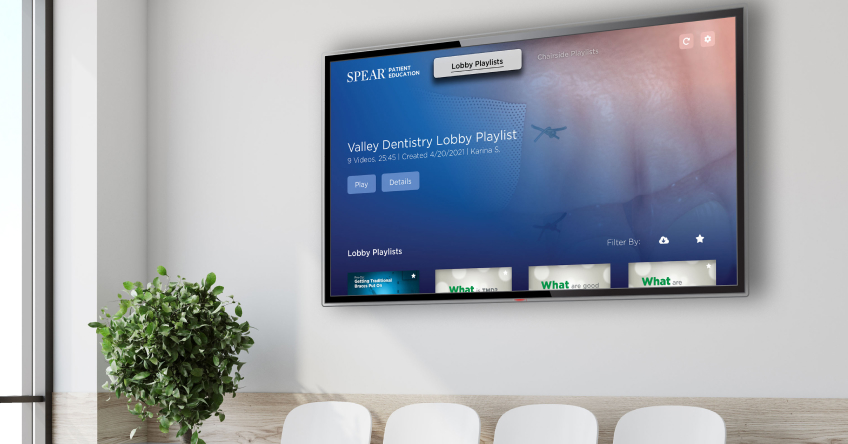
Your dental waiting room television can be a great way to distract and educate patients in the lobby, but it doesn’t stop there. Adding chairside videos and email videos to the equation allows you to customize your playlist to your patient’s needs and improves patient case acceptance. This part of the patient experience can help put them at ease while empowering them to take control of their dental health.
How Dental TV Improves Patient Experiences
People tend to underestimate the duration of positive experiences and overestimate negative ones. In fact, in one study of consumer queuing, customers retroactively estimated that they waited 78% longer than they had! But that same study also found that simply adding a clock dropped those perceived wait times to only 22% longer.
That’s because that simple clock does two things. It distracts the patient from their wait time while educating them on the exact amount of time that has passed. Lobby dental TV works the same way. It distracts the patients, so they’re not focused only on the wait, and it educates them about their procedures.
It also goes a long way toward alleviating dental anxiety. About 36% of patients suffer from some dental fear. Dental TV can help by improving the overall experience and reducing the patient’s pain perception during treatment.
| Distraction | Education |
| In one study on distraction and pain perception, patients were given two passive distractions (listening to music and looking at images) and one active distraction where they had to engage in an activity. In all three instances, their perception of pain was reduced. In the activity, the pain signals themselves were suppressed. | In another study, specifically on dental TV programming, about 48% of dental patients were spurred to take action after viewing brief health promotion advertisements for obtaining preventative and emergency treatment. |
| Improved Patient Experience | |
| Dental TV can reduce patients’ perceptions of pain, wait times, and anxiety while empowering them to manage their dental health. | |
Of course, the benefits of dental waiting room TVs aren’t automatic. You must provide the proper programming based on your patients’ treatment and carefully time it.
Creating a Personalized Playlist to Engage Patients
While programming delivered in the lobby can powerfully impact patients, those effects are even stronger chairside. You can program and time a playlist to engage that specific patient. Dental waiting room TV programming will be more general and aimed at a broad audience.
In either case, it’s essential to avoid repetition. We’ve all been in that waiting room where the duplicate content plays on a loop, over and over again. If patients must watch the same video as they wait or receive treatment, their perception of that time will increase. What was initially engaging has now become monotonous. That’s why it’s essential to use a comprehensive and frequently updated content library to share with patients. Here are other best practices for using the dental waiting room TV chairside.
Analyze and Match Your Appointment Timelines
Looking at the data in your practice management system should give you a good idea of the duration of your procedures. You can use that list of times to establish outlines for your playlist. For example, if you were completing an initial patient appointment, you would review the various steps involved (examination, X-rays, cleaning) and then establish blocks of time for those parts. Then, you align your playlist and its content with that time frame.
Categorize and Create Playlists
Organize your content library into categories based on the treatment windows you established earlier. For example, you could create a type for a comprehensive initial patient visit where the patient reports no severe issues. That visit includes a patient exam, X-rays, and cleaning, lasting approximately 1 hour. In your playlist, you would include a 15-minute video explaining a comprehensive exam, a five-minute one that goes over X-rays, and a third ten-minute video that educates the patient on good brushing techniques. The video playlist is shorter than the overall patient visit, about 50% of the allotted time, to allow the patient time to speak with the doctor, transition between stations, and answer questions.
You would create alternate playlists for other treatments your practice provides. You may have different video playlists for standard procedures, including:
- Fillings: This playlist might include videos explaining the filling procedure, different types of fillings, and post-treatment care instructions.
- Teeth whitening: A playlist for this category might feature videos on teeth whitening options, benefits, and precautions, along with before-and-after visuals.
- Orthodontic treatment: Here, the playlist would include videos on different orthodontic options, such as braces or aligners, and their benefits and maintenance.
- Periodontal therapy: This category should include assets that go over gum disease, scaling, root planing procedures, and tips for maintaining healthy gums.
- Dental implants: Finally, you could feature videos explaining the implant process, benefits, and aftercare instructions for patients considering dental implants.
By organizing your content library into categories and creating playlists tailored to specific treatments, you can provide targeted educational materials to your patients.
Keep Content Current
When something is mundane or repetitive, it slows down time for your patients. It may even increase their perception of pain. Repetitive videos will undo all the good that dental waiting room TV creates. If every time the patient comes in for an exam, they have to watch the same video on dental hygiene, it will become a chore rather than a tool.
Keep your content library up-to-date. Add videos that include the latest advancements in dentistry, new techniques, and emerging trends. This will keep content fresh and show your patients that you’re on the cutting edge of dentistry.
Consider Interactive Elements
In the study mentioned earlier on how distraction can reduce the perception of pain, the most effective method included an activity that required the individual to interact and respond. This didn’t just reduce the patient’s perception of pain; it affected how pain signals moved through their body. The pain signals were disrupted and repressed when the patient was distracted by the task.
Interactive content like quizzes, surveys, or educational games can recreate that in your practice. They distract the patient during treatment and help them retain the knowledge they gain. These can be especially effective in pediatric dentistry, though it’s a strategy that works with all patients.
Using Spear Online’s Patient Education Videos to Improve Patient Case Acceptance
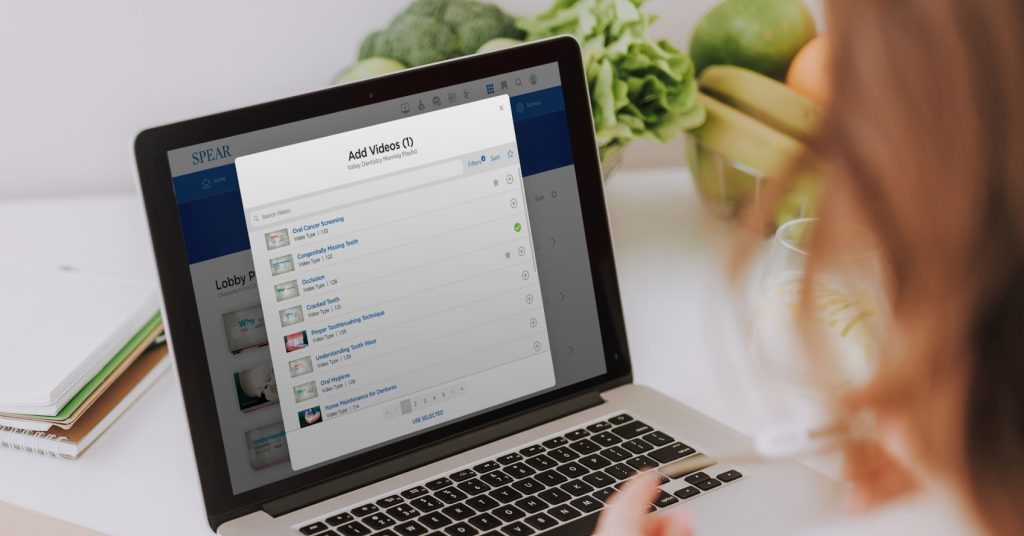
An excellent content catalog for your dental waiting room TV is critical to improving the patient experience. You should be able to build playlists based on your patients’ needs so you can customize the content they see. With a Spear Online membership, you can access a library of over 250 patient education resources to build customizable playlists for mobile experiences and practice TVs. That membership is much more affordable than the $500 that many companies charge for this as a standalone service. Providing resources like this to your patients not only eases their fear of procedures but also increases your patient case acceptance.
SPEAR All access
One Membership, $555 More a Day
Practices on Spear All Access see a median daily production gain of $555, with a 9.9% median lift in hygiene production. That’s not from one course or one workshop. It comes from unlimited Spear and CDOCS workshops, the full online course library, role-based team training, practice analytics, and a dedicated Practice Growth Partner working with your team every month, all in one membership.
Featured Digest articles
Insights and advice from Spear Faculty and industry experts