- Article
- Practice Management
OSHA Guidelines in Dentistry: Keeping Staff Safe and Records Compliant
Spear Team
•
January 10, 2023

The Occupational Safety and Health Administration (OSHA) is an agency tasked with ensuring workplace safety. Over 2.5 million workplace injuries and illnesses are reported yearly, but we rarely consider them in dental offices. When someone is injured at work, we tend to think of heavy industry or high-risk positions. However, medical and dental offices have hazards that must be managed. Here are a few OSHA guidelines in dentistry that will help keep workers safe and hazard-reporting compliant.

Breaking Down OSHA Guidelines in Dentistry
In 2020, illnesses and injury cases in the health care and social assistance sector jumped by 40%, with COVID-19 being the obvious culprit. That is why it’s important to reiterate the guidelines offices should follow as they return to full patient capacity.
In dental offices, the obvious concerns lie in bloodborne pathogens and infection protocols. Workers may also face exposure to hazardous materials like beryllium or nitrous oxide. Dental offices should adhere to OSHA’s “General Duty Clause” when establishing guidelines.
(a) Each employer — (1) shall furnish to each of his employees employment and a place of employment which are free from recognized hazards that are causing or are likely to cause death or serious physical harm to his employees; (2) shall comply with occupational safety and health standards promulgated under this Act. (b) Each employee shall comply with occupational safety and health standards and all rules, regulations, and orders issued pursuant to this Act which are applicable to his own actions and conduct.
Of course, that is an extremely broad explanation. For simplicity’s sake, we can break it down into the following components specific to dentistry:
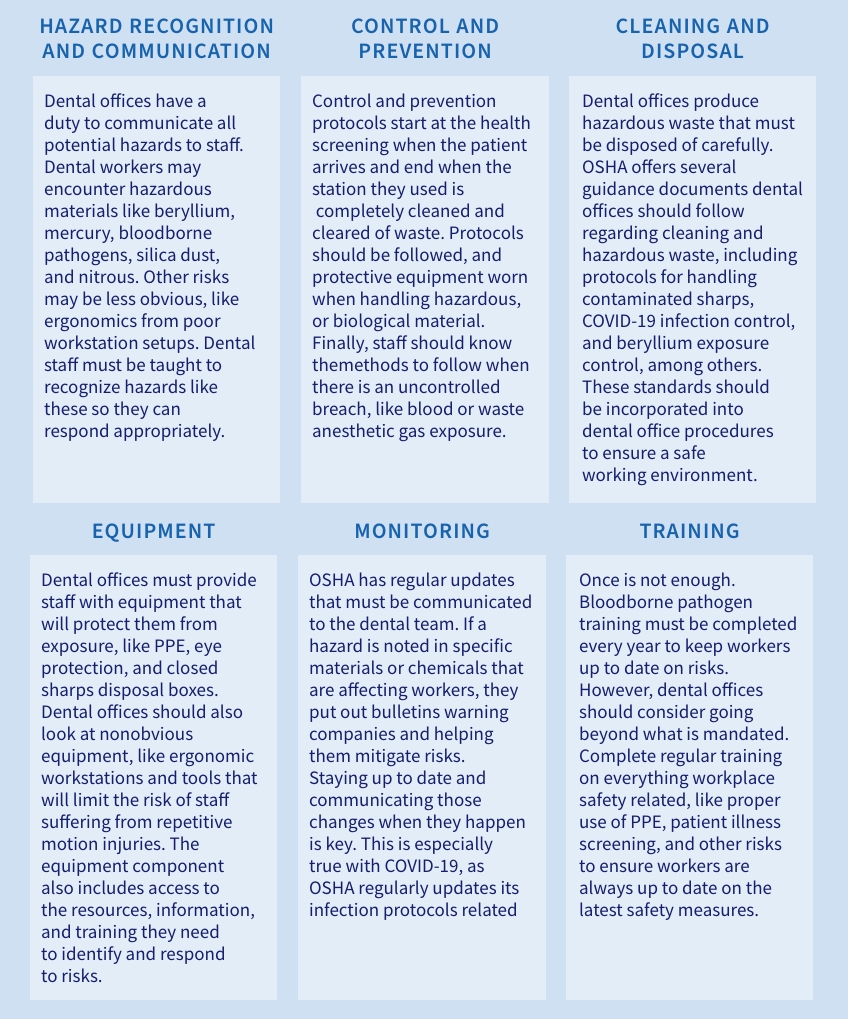
One segment that is absent from the above list is OSHA records keeping. That is a topic in and of itself, which will be summarized below.
Records Keeping for OSHA Compliance in Dental Offices
While dental offices are considered partially exempt from many OSHA reporting standards, they are still required to report serious injuries or deaths within 24 hours and 8 hours, respectively. Serious injuries are defined as injuries that result in inpatient hospitalization or the loss of a limb or eye.
An online report submitted to the agency should include the following information:
- Establishment name
- Location of accident
- Time of accident
- Reportable event type (fatality/hospitalization, etc.)
- Number of involved employees
- Names of involved employees
- A description of the event
- Your contact person
While detailed reporting is usually only required in the event of serious injuries, it is still a good practice to record all reported injuries. Also, remember that OSHA is not synonymous with workers’ compensation.
Workers’ compensation is the required financial protection you provide your workers in the event of workplace injuries. A different agency than OSHA governs it and will have its own reporting requirements that are usually far more stringent.
That’s why it’s a good policy to document all the OSHA guidelines in dentistry your practice follows. No practice wants to have a workplace injury, but following protocols and updating them regularly can help mitigate the risk.
SPEAR All access
One Membership, $555 More a Day
Practices on Spear All Access see a median daily production gain of $555, with a 9.9% median lift in hygiene production. That’s not from one course or one workshop. It comes from unlimited Spear and CDOCS workshops, the full online course library, role-based team training, practice analytics, and a dedicated Practice Growth Partner working with your team every month, all in one membership.
Featured Digest articles
Insights and advice from Spear Faculty and industry experts