- Article
- Practice Management
Dental Patient Retention Strategies That Support Practice Growth
Spear Team
•
August 2, 2022
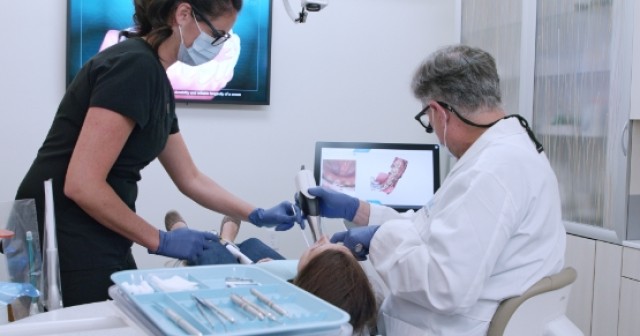
Dental patient retention strategies are top of mind for many practices as they continue to recover from business disruptions. Approximately 40% of dental practices report being open but are seeing lower patient volume than usual. As patients return to treatment and are even more cost-conscious than ever, retention will be critical for business resilience. This issue can be addressed through data-driven, unbiased decision-making.
What do dental patients want?
What better way to understand what patients want than by looking at why they choose to leave a practice? Absent COVID-19-related reasons or costs, dental patients report three main factors that would cause them to switch dentists:
- Location: It’s no surprise that location is a significant factor for any business, including dental practices. Approximately 17% of patients reported that they would leave a dentist if it were located in an inconvenient area.
- Dentist’s Attitude: About 10% of survey respondents state they would leave a practice where the dentist criticizes their teeth or oral care.
- Late Appointments: Nearly 10% of those surveyed stated that they would consider changing practices due to late appointments.
These factors are important in developing relationships with dental patients that will keep them in the practice. However, addressing them can be a challenge without the right approach.
Evaluating the total care experience
The best dental patient retention strategies address the whole patient lifecycle and remove barriers that lead to poor experiences.
To get started, practices should assess six areas:
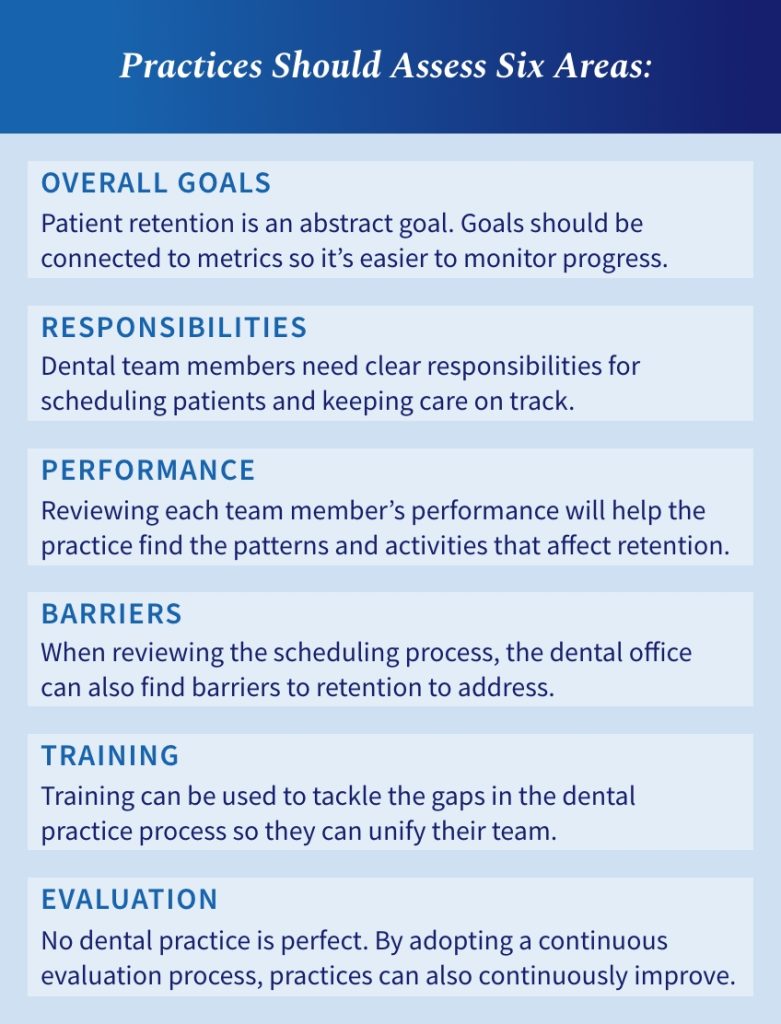
Flow is necessary to ensure dental patient retention. That flow means that the patient arrives for their appointment, and appropriate follow-ups are scheduled immediately after. All barriers to care, like billing issues or excessive patient wait times, are eliminated through the use of technology and granular-level metrics.
Tools and tips to improve dental patient retention strategies
The biggest barrier to patient retention is information. A practice cannot fix problems that they don’t know about. Armed with the right data, practice management can address the reasons dental patients leave and boost their retention.
Here are three tips for starting out:
1. Go data-driven
All enterprises, regardless of industry, should take a data-first approach to business decision-making. In a dental practice, metrics surrounding scheduling, billing, patient interactions, and individual team member performance can help drive decisions that increase retention.
For example, a dental practice may notice particularly low patient retention rates using a specific insurance plan. They examine the data more closely to discover that the issue is isolated to a few billing clerks who are incorrectly submitting claims, resulting in the patient having a much higher out-of-pocket cost than expected. Then take steps to address the issue and increase retention through proper training.
2. Use technology to fill gaps
Some patient retention barriers can’t be defeated with training alone. Consider one of the highest reasons dental patients reported switching providers: inconvenient location. Knowing that is the problem won’t help a dental practice that’s unable to pick up and move. But there may be a more cost-effective way to tackle the issue.
Telemedicine services exploded during COVID-19. The overall market size is expected to reach $25.88 billion by 2027, and for good reason. Telemedicine makes care more accessible for individuals who can’t travel. While it can’t eliminate the need for in-office visits, it does clear the physical office schedule for higher-priority appointments.
Teledentistry is a subset of telemedicine that’s growing quickly. Using mobile devices and webcams, dentists are able to review and even diagnose patient complaints without them ever coming into the office. It can also be used in satellite offices, where dental team members can provide services under the direction of their dentist, even without them being in the office. In fact, two-thirds of dentists believe that teledentistry will reduce costs for their practice, with up to 75 percent noting it’s useful for improving patient care.
Of course, teledentistry isn’t the only technology that will help dentists. Some practices may benefit from simply updating their software to an integrated solution that streamlines data collection.
A platform that connects scheduling, billing, and dental team metrics would be necessary to address the example scenario from earlier, where patients with a specific insurance plan have low retention rates. A non-integrated system that keeps this information siloed would make it very difficult to make this connection. Of course, all of this depends on the ability to interpret data correctly and take the right steps. For this, it may help to work with an outside consultant.
3. Gain an outside perspective
It can be challenging to review things objectively from one’s own perspective. Most dentists join the field because they like helping people. The business aspect is less appealing. They may choose to hire a practice manager, but a disconnect still exists between patient care and business decisions. An outside consultant can review the practice as a whole, compare it to the data, and make better decisions.
Combining data-driven decision-making with consultation is possibly one of the most powerful dental patient retention strategies. It gives practices an end-to-end view of their practice, so they can see where barriers to patient retention lie.
SPEAR All access
One Membership, $555 More a Day
Practices on Spear All Access see a median daily production gain of $555, with a 9.9% median lift in hygiene production. That’s not from one course or one workshop. It comes from unlimited Spear and CDOCS workshops, the full online course library, role-based team training, practice analytics, and a dedicated Practice Growth Partner working with your team every month, all in one membership.
Featured Digest articles
Insights and advice from Spear Faculty and industry experts