- Article
- |
- Implants
- |
- Techniques / Materials
Tooth Supported Fixed Bridge for Missing Maxillary Incisors
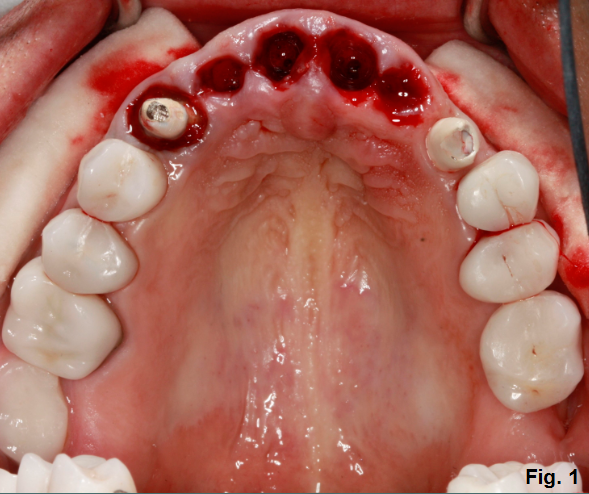
This patient has decided to have his upper maxillary incisors removed following a significant dental history that includes endodontic treatment, clinical crown lengthening, full coverage restorations and trauma. (Fig. 1)
Certainly, there are several restorative options available for treatment. Tooth supported fixed bridge, dental implant supported fixed bridge, individual dental implant supported restorations, removable partial denture and of course – no treatment. When there are several options available, it is really our responsibility to help the patient make the decisions on the options available based on their unique situation and circumstances.
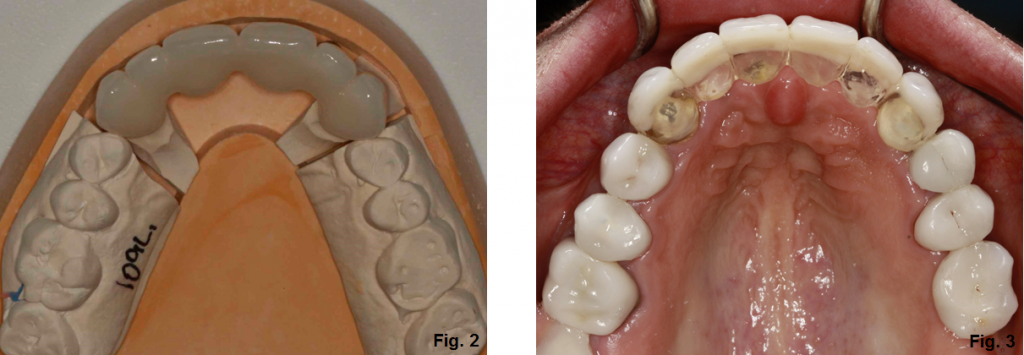
Let’s assume, for the sake of discussion, that the patient is interested in a tooth supported fixed bridge restoration canine to canine in the anterior maxillary segment. (Fig. 2) An understandable option for treatment in a typical scenario, however, would your thoughts change with a natural tooth in the #6 position and a dental implant in the #11 position? The tooth supported fixed bridge provisional connects the canines – how long would we like this provisional to be serviceable for the patient? (Fig. 3)
A couple thoughts before we discuss the tooth supported fixed bridge option…
Fresh extraction sites visible in the photos certainly lead to the question as to whether or not the labial plate of bone is intact or fractured for each of the incisors. Will augmentation or grafting be indicated and how will that impact the provisional restoration? What about lip length and lip mobility particularly as it pertains to gingival display?
Connecting natural teeth to dental implants has been an area of controversy – certainly the treatment has been executed successfully, however there are many documented cases resulting in intrusion of the natural tooth abutment. A canine to canine fixed bridge restoration is typically outside the range of what is studied in the literature as it is likely not a scenario where we could find an adequate sample size for statistical analysis.
In an article by Luca Cordaro, et al, a connection is made to predict when natural teeth are less likely to intrude when connected to dental implants functioning as abutments. They found that teeth with reduced periodontal support appear to handle the use of mixed abutments (implants and natural teeth) without intrusion.
What types of discussion items would be important for the patient to know prior to this point? What would you like to know based on what you see in the clinical photo?
Douglas G. Benting, DDS, MS, FACP, Spear Visiting Faculty and Contributing Author. [ www.drbenting.com ]
References
- Cordaro, et. al. Retrospective evaluation of complete-arch fixed partial dentures connecting teeth and implant abutments in patients with normal and reduced periodontal support. Journal of Prosthetic Dentistry 94(4):313-320;2005.
VIRTUAL SEMINARS
Stay Sharp. Stay Current. Stay Ahead.
Join live, focused training designed to help you implement immediately and strengthen your expertise.

By: Doug Benting
Date: October 20, 2014
Featured Digest articles
Insights and advice from Spear Faculty and industry experts