Treating Class V Lesions
In a previous article, I reviewed my steps when working with direct composites in the posterior. For this article, I’d like to review the steps I use for placing direct composites in Class V lesions. Class V lesions, commonly referred to as cervical erosion, and in the literature as noncarious cervical lesions, can be complicated to restore predictably.
Tay and Pashley described the bonding difficulties well in a review article, citing the following challenges:
- Mineral salts occlude the dentinal tubules, which prevents resin tag formation
- Many parts of the lesion show a hypermineralized surface that resists self-etching primers and phosphoric acid
- Significantly lower bond strengths than normal dentin due to the sclerotic nature of the dentin in the occlusal, gingival
- Deeper layers of the lesion
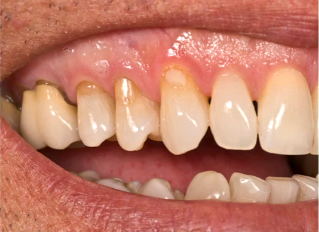
The patient I’ll be using, for example, has multiple old Class V restorations and is unhappy with their appearance because of staining and his very high smile line. He also has lesions that haven’t been treated, yet he would like to have them restored to look better.
While the etiology of Class V lesions is a frequent topic of debate, generally citing occlusal stress (abfraction), abrasion (tooth brush and toothpaste), and finally corrosion (acid), the one thing I can tell you about this patient is that occlusal stresses do not cause his lesions. He actually has a premolar open bite; his anteriors and molars are all occluded, but there is no premolar contact, no matter how he moves.
Here is how I typically treat patients who present with these issues, again noting as in the previous article on posterior composites that there are a multitude of products and techniques that can be used successfully. I will simply present my technique.
Blending the composite
I want to blend the composite well on the occlusal, mesial, distal, and gingival margins to treat this patient and his esthetic desires. As we all know, this can be challenging. In addition, I want to minimize the risk of future marginal staining, which can be a problem for all Class V restorations, particularly on the gingival margin.
For these two reasons, I bevel the enamel. Typically I create a 1-mm-tall bevel in the occlusal margin, and a 0.5 mm bevel on the mesial and distal; doing this allows the composite to become more translucent and less noticeable. Very rarely, there can be some room between the most cervical aspect of the lesion and the gingiva; in this case, I will put a slight bevel on the cervical as well.
To solve some of the challenges in dentin bonding cited by Tay and Pashley, I air-abrade the completed preparation with 50-micron aluminum oxide. Other authors have shown increased retention just from roughening the dentin with a diamond if you don’t have access to air abrasion.
The other choices are whether to use a self-etching dentin adhesive or a total-etch system, and whether to use a microfilled composite or hybrid. The literature clearly shows that all the materials just mentioned can be used successfully, although with minor variations in overall retention rates and staining.
I always use a total-etch two-step system, such as 3M Single Bond Plus, because sclerotic dentin is highly likely for these patients. I also etch each tooth for 30 seconds with phosphoric acid rather than 15 seconds, which has been shown to have a better chance of getting a hybrid layer formed in highly sclerotic dentin. The etchant is then rinsed off, and Gluma desensitizer is applied for 20 seconds, lightly dried, and followed by the dentin adhesive. The adhesive is light-cured, and then composite placement can begin.
Contraction during composite curing
Class V restorations can be challenging to fill because of the contraction during composite curing. Typically during the contraction, the risk is that the weakest bond will fail as the composite shrinks, leading to premature leakage and staining.
Because the weakest bond will be the cervical margin, assuming the other margins are enamel, I incrementally fill my Class Vs. The first increment is to fill up the deepest portion of the preparation. This increment is then cured. Next, the occlusal and cervical increments are placed from mesial to distal, but not touching each other. Finally, the middle section is completed. I personally use hybrid composite for my Class Vs, but I recognize many prefer microfills.
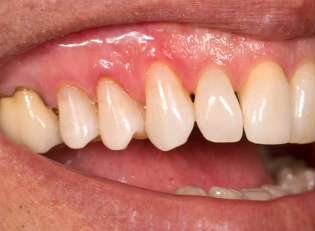
I typically finish by rubber-polishing abrasive points and discs to achieve the final shape and polish you see in the final photograph. Note that the photo is from the appointment where the composites were placed, so the tissue is somewhat irritated and the teeth have dehydrated slightly.
VIRTUAL SEMINARS
The Campus CE Experience
– Online, Anywhere
Spear Virtual Seminars give you versatility to refine your clinical skills following the same lessons that you would at the Spear Campus in Scottsdale — but from anywhere, as a safe online alternative to large-attendance campus events. Ask an advisor how your practice can take advantage of this new CE option.

By: Frank Spear
Date: July 27, 2017
Featured Digest articles
Insights and advice from Spear Faculty and industry experts