- Article
- Esthetics
Evaluating Facial Esthetics: Vertical Proportion
Frank Spear
•
July 7, 2017
Restorative dentists often don’t realize that a patient who’s unhappy with their appearance may require significant alterations to improve their smile that are far beyond restorative changes to the appearance of the teeth.
This series of articles will address how I assess a patient’s face to determine if the patient may benefit from orthodontic or orthognathic intervention to achieve a better final result.
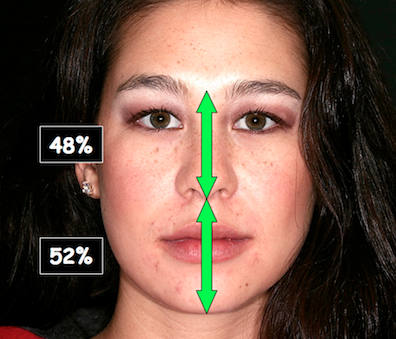
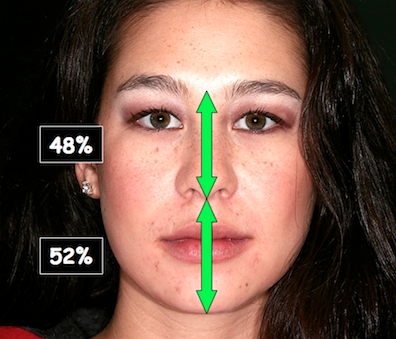
The first place I start is evaluating the patient’s vertical facial proportion in a photograph taken with the face at rest. An orthodontist typically does this on a cephalometric radiograph, but we can get a reasonable evaluation from a facial photograph.
- Midface: The midface is the section from the glabella, the prominent bump between the eyebrows as the forehead transitions down to the bridge of the nose, and the base of the nose.
- Lower third of face: The lower third of the face is the distance from the base of the nose to the bottom of the chin. The lower third of the face is affected significantly by several factors — some dental, others skeletal.
Normal facial proportion is typically a midface-to-lower-third ratio of 50:50 or 45:55. When the face varies significantly from these numbers, some predictable esthetic issues start to arise.
A relatively common finding is a long lower third of the face, resulting in ratios of 40:60 or even greater. Patients with long lower thirds will typically have steep mandibular plane angles, long narrow-looking faces and show significant gingival display in their smile. This occurs due to the maxillary teeth erupting during growth and development to follow the mandible as it grows, but in patients with long lower thirds, the mandible has moved farther down, resulting in excessive maxillary eruption. This also shows in their tooth display with the lip at rest, as they may show 6, 7, 8, or even 9 mm of central incisor with their lip at rest.
Treatment of patients with long lower thirds is typically orthodontics and orthognathic surgery, a maxillary impaction, sometimes accompanied by mandibular surgery as well. The patients’ complaints about their smiles are generally always about the excess gingival display, but crown lengthening and restorations can’t usually alter the display adequately because it’s really a skeletal problem.
If the patient doesn’t choose the surgery, Botox can have a beneficial impact by reducing lip mobility and therefore the total amount of gingival display.
A less common but very difficult problem is a short lower third of the face. This can occur from a simple loss of vertical dimension, as in a patient who is edentulous. If vertical dimension problems are the cause, then obviously a dental solution can be effective.
A more serious challenge is when the patient has all their teeth and they are unworn, yet the lower face is very short. In these patients, the major problem is a lack of tooth display due to undereruption of the maxillary teeth. In minor cases, the solution may be orthodontic but in severe cases, the solution is generally orthognathic. This involves rotating the maxilla down in the anterior, followed by surgery on the mandible and thus rotating it down in the anterior as well. The surgery doesn’t just correct the tooth display but changes a very short, square face into a much more attractive, normally proportioned face.
The bottom line is that if you are contemplating esthetic treatment for a patient with excessive tooth and gingival display, or almost no tooth display with unworn teeth, evaluate the face first. If the root of the problem is skeletal, it’s unlikely restorative treatment will provide the best result.
SPEAR campus Workshops
Learn Hands-on From Faculty Who Still Practice
A few days at Spear Campus can change how you diagnose, plan, and present cases, not through more lectures, but through hands-on training led by faculty who treat patients every week. Work through real cases in small groups and leave with techniques you can use on your next patient.
Featured Digest articles
Insights and advice from Spear Faculty and industry experts