- Article
- Practice Team
Dental Terms in Spanish To Help You Connect With Patients
Spear Team
•
February 22, 2024
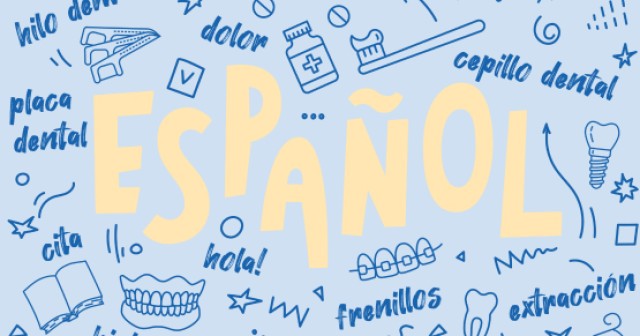
Fifty-seven million people in the United States speak Spanish. Those individuals who only speak that language may find that they cannot communicate when they need it most, such as during a medical emergency. In fact, 49% of patients who did not speak the local language reported confusion over their medical care, while 15.8% suffered a consequence like a bad medication reaction. To better support your patients, learn these dental terms in Spanish and services you can use to break communication barriers.
25 dental terms to know in Spanish
Achieving fluency in any language typically requires 2–3 years of consistent study — a valuable goal that enhances patient communication and improves their experience. However, complete fluency is unnecessary when conveying many treatments and plans to patients. Here are 25 essential dental terms in Spanish to facilitate communication.
| English Word | Translation (and Pronunciation) |
| Appointment | Cita (SEE-tah) |
| Braces | Frenillos (freh-NEE-yos) |
| Bridge | Puente dental (PWEN-teh den-TAHL) |
| Cavity | Caries (CAH-ree-ays) |
| Cleaning | Limpieza (leem-pee-EH-sah) |
| Crown | Corona dental (koh-ROH-nah den-TAHL) |
| Denture | Dentadura (den-tah-dOO-rah) |
| Enamel | Esmalte (es-MAHL-teh) |
| Extraction | Extracción (ex-trahk-see-ON) |
| Filling | Relleno (reh-YAY-no) |
| Flossing | Hilo dental (HEE-lo den-TAHL) |
| Gum disease | Enfermedad de las encillas (En-fehr-meh-DAHD de las en-SEE-ahs) |
| Implant | Implante dental (im-PLANT-eh den-TAHL) |
| Mouthguard | Protector bucal (pro-tehk-TOR boo-KAHL) |
| Oral hygiene | Higiene oral (ee-hee-EN-eh or-AL) |
| Plaque | Placa dental (PLAH-kah den-TAHL) |
| Pain | Dolor (doh-LOHR) |
| Retainer | Retenedor (reh-teh-neh-DOHR) |
| Root canal | Conducto dental (con-DOOK-toh den-TAHL) |
| Sensitivity | Sensibilidad dental (sen-si-bee-lee-DAHD den-TAHL) |
| Tooth | Diente (DYEN-teh) |
| Toothbrush | Cepillo dental (seh-PEE-yo den-TAHL) |
| Treatment | Tratamiento (trah-tah-ME-YEN-to) |
| Whitening | Blanqueamiento dental (blan-kay-ah-ME-YEN-to den-TAHL) |
| X-ray | Radiografía (rah-dee-oh-grah-FEE-ah) |
These terms may help you express the basics to your Spanish-speaking patients. However, to truly communicate, you must employ some tools and resources for your team.
Tools to close language barriers in dental practices
Thanks to technological development, translation has come a long way. Dental practices that want to close language barriers have a wide range of options. Of course, not all solutions are equally effective, and not all options are affordable for every practice.
Here are a few translation options for your dental practice, as well as their pros and cons.
| Translation type | Pros | Cons |
| Professional Interpreters. These trained individuals proficient in both the source and target languages facilitate communication between parties. | Accurate and dependable. Ensure clear communication. | May be expensive. Require scheduling in advance. |
| Language translation apps. Mobile or web applications can use artificial intelligence to translate text or speech from one language to another. | Instant translation. Cost-effective or free. | May lack nuance. Relies on technology, which can have errors. |
| Translation services. Companies or agencies offer professional translation services, often for written documents or more complex communication needs. | Offer a wide range of translations in both verbal and written formats. Can manage large volumes. | Cost may vary. Turnaround time may not be immediate. |
| Language access lines. Telephone services provide immediate access to interpreters for real-time translation over the phone. | Immediate access to interpreters for dozens of languages. 24/7 availability. | Costly, especially for frequent use. May lack personal connection. |
| Translated written materials. Documents, brochures, or educational materials are translated into different languages to provide information to patients in a written format. | Permanent reference for patients. Ensure accuracy. | Time-consuming to create. Limited to written communication. |
These tools, while helpful, are all external to your practice — you will need to depend on third-party services to provide the translation. While they can be a great supplement, you shouldn’t depend on them alone. Instead, build diversity into your practice through hiring and professional development.
Building a more diverse dental practice
Dental anxiety affects an estimated 36% of patients, and a big factor in alleviating that anxiety is communication. When your patients understand the care and instructions they’re given, their anxiety decreases and oral health improves. While many translation tools can help eliminate communication barriers, they don’t replace the ability to speak to a dental professional who is fluent in their language.
Hiring a diverse team and developing the skills of your existing staff can help you close the language gap in your practice. Here are some tips to improve:
- Expand your hiring. Actively seek candidates with diverse language skills when hiring. You can find many candidates at postsecondary schools, or through community outreach programs. By broadening your recruitment efforts, you increase the likelihood of building a team that reflects the linguistic diversity of your patient population.
- Offer language training. Provide language training for team members to improve communication skills. You can start by training all your staff on common dental terms in Spanish, and then offer more detailed training to those who express an interest in expanding their fluency. This type of program is a win/win: Your team member learns a second language, while your practice benefits from greater language diversity.
- Incorporate cultural competency training. Incorporate cultural competency training to understand patient backgrounds. This helps to enhance your team’s sensitivity to cultural differences, promoting better understanding and communication with patients from diverse backgrounds.
- Encourage language exchange. Foster a workplace culture that supports language exchange among staff members. Create opportunities for team members to practice and improve language skills by encouraging language exchange within the team.
- Provide multilingual resources. Ensure your practice has readily available multilingual resources, such as pamphlets and educational materials. Consider simple things, like the signs your office uses to direct patients. Do they reflect the languages they read at home? If not, consider adding these options to build a more inclusive environment.
- Seek patient feedback. Regularly gather patient input to understand their language-related challenges. This allows you to make continuous improvements in language access and communication.
Learning dental terms in Spanish to help your patients is just the beginning. By building greater cultural diversity in your workplace, you embed that closeness and understanding directly into the fabric of your practice. This enhances communication and fosters an environment where patients feel seen and valued. The benefits extend beyond language proficiency, creating a more inclusive, culturally competent practice better equipped to provide exceptional care to a diverse patient population.
Spear Team Training
Train Your Entire Team, Not Just Yourself
Clinical confidence doesn’t stop with the doctor. Spear gives every role in your practice, hygiene, assistants, and front office, structured training built for their part of patient care, including the Hygiene Excellence Program. When the whole team learns from the same curriculum, your practice runs with more consistency, not just your chair.
Featured Digest articles
Insights and advice from Spear Faculty and industry experts