- Airway
- Article
Referring Orofacial Myofunctional Therapy for a More Complete Treatment Plan
Brittny Sciarra
•
July 21, 2022
Dentistry has evolved to include numerous preventive practices, which the public may assume result in absolute prevention with regular visits. Unfortunately, there are many factors involved in orofacial pain, periodontal disease, caries, and occlusal management. Because of this, elimination is a lofty aspiration, and unachievable in many cases. Orofacial myofunctional therapy may be the modality that mitigates the intersection of prevention strategies and referrals, providing your patients with a complete treatment plan.
One in six general dentistry patients presents with orofacial pain as a chief complaint, but few general dentists can treat them adequately within their dental office.1 The introduction of a researched method for relief from neuromuscular-sourced temporomandibular joint disorder provides an opportunity for dental providers in office.2 Inclusion of orofacial myofunctional therapy screening and evaluation in periodontal protocol can also contribute to stabilizing chronic periodontal disease progression.3 Additional relief from bruxism that damages occlusion and compromises dental treatment is another benefit of including this dynamic modality within the dental office as an inside or outside referral.4
Integrating orofacial myofunctional therapy into your practice
Integration of orofacial myofunctional therapy in the dental practice requires three key considerations:
- Patient experience
- Safe practice
- Collaboration
Each is an essential layer in the effective implementation of this unique referral and treatment modality. Implementing and introducing something new into the office takes delicate concern and a proven process to achieve smoothly and successfully.
The patient experience
The patient experience is at the forefront in all aspects of the dental practice. It’s essential that the patient understands what is occurring throughout the process for the best experience. This reduces confusion that often leads to distrust or conflict. The front desk staff should be knowledgeable enough to clearly convey and reiterate the reason for referral.
Consistency is key for patient experience. Think through every aspect of the referral process by thinking through the following questions:
- How does the patient first hear about myofunctional therapy? In addition to your staff training, provide marketing materials or videos in the waiting room.
- What’s the first step when you discover a sign of orofacial myofunctional disorder? Determine how this information will be shared with your patient. This could simply be a notation in the file to reevaluate at the next visit, or this may result in immediate referral and patient education.
- How do you refer patients? This could be a referral note, flyer, or simply requesting the patient contacts the therapist directly using information on the business card. Ensure all members of the staff understand the flow of information with minimal deviation from the plan.
The role of a myofunctional therapist
The roles and duties of a clinical dental hygienist are vastly different from those of a clinical myofunctional therapist. Separation is key.
Since 1992, the American Dental Hygienists Association has adopted a practice recommendation that encourages interested licensed dental hygienists to pursue additional training in orofacial myofunctional therapy. This unfortunately has not translated to established written regulation within any of the 50 state dental practice acts. It does not prohibit a dental practice from adopting that modality into their practice, nor a registered dental hygienist from practicing.
A myofunctional therapist should not be clocked in or receiving pay while working as a registered dental hygienist actively in office. Imagine paying a registered dental hygienist their typical wages in the dental office while they teach a yoga class. The two are unrelated, and as such should be separate.
Whenever possible, ensure there is a clear distinction between the registered dental hygienist and orofacial myofunctional therapy roles in the dental practice — separate payroll, clocks for timesheet tracking, electronic health care software, registration paperwork, accounting, and expenses. This ensures that should the dental board ever receive a complaint, the roles were not intertwined and ineligible for rule by the board.
Health impacts of orofacial muscular dysfunction
Collaboration plays a critical role in the integration of orofacial myofunctional therapy within the dental office. Resolution of orofacial muscular dysfunction (OMD) is rarely ever the only problem a patient with orofacial myofunctional disorders suffer from. Interdisciplinary care and team management will result in optimal results. The figure below shows the multitude of manifestations of airway-centered disorders. Having a network that includes a feeding therapist, speech language-pathologist, occupational therapist, lactation consultant, manual therapist, and medical physician will ensure every patient is addressed in totality.
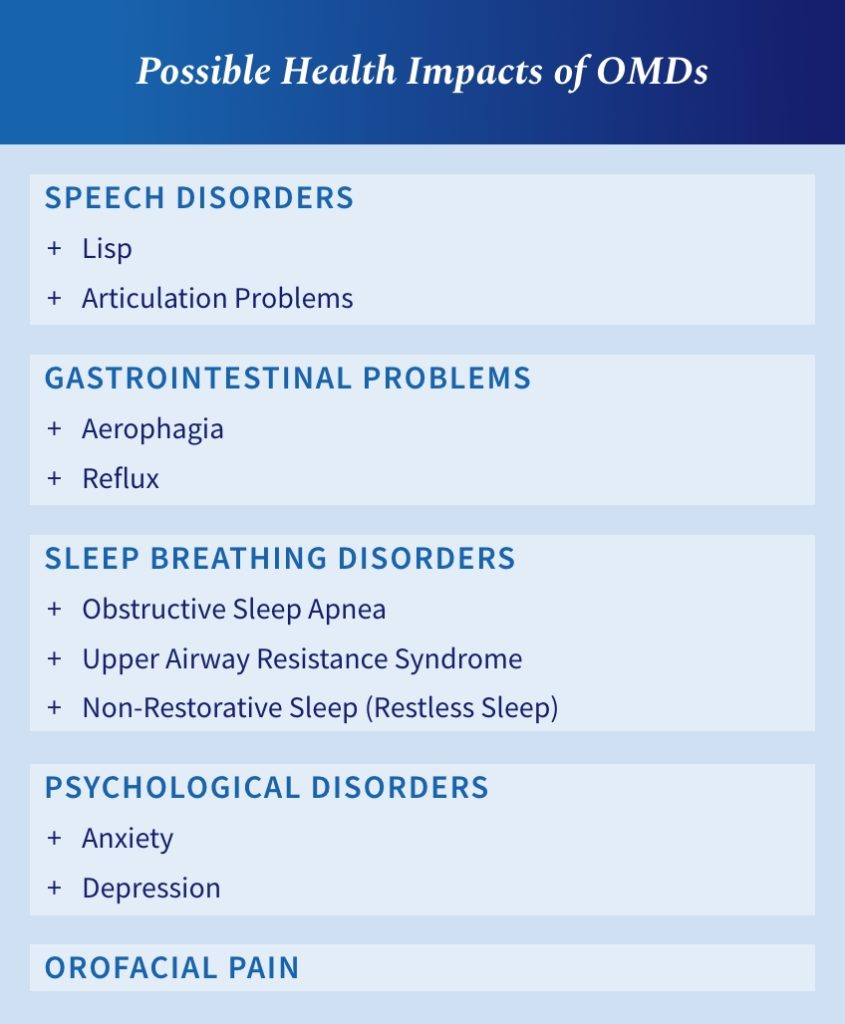
When implementing outside of the office, the referred myofunctional therapist is a great resource for staff education. They may be able to provide a lunch-and-learn lecture with all the essential information for effective patient communication. Many small or digital courses exist to educate staff on orofacial myofunctional therapy without having to register for a multiday complete introductory course.
While it may not be your goal to implement orofacial myofunctional therapy into your practice, it’s beneficial to your patients and your practice growth and retention to begin using myofunctional professionals in your treatment plans.
Brittny Sciarra is a registered dental hygienist, myofunctional therapist, and Buteyko Breathing educator, leader and mentor. Brittny is the founder of CT Orofacial Myology and co-founder of MyoAir.
Karese Laguerre is a registered dental hygienist, myofunctional therapist, author, educator, key opinion leader in sleep and myofunctional therapy, and founder of The Myo Spot.
References
- de Felício CM, de Oliveira MM, da Silva MA. Effects of orofacial myofunctional therapy on temporomandibular disorders. Cranio. 2010 Oct; 28(4):249-59.
- Messina G, Martines F, Thomas E, Salvago P, Fabris GBM, Poli L, Iovane A. Treatment of chronic pain associated with bruxism through myofunctional therapy. Eur J Transl Myol. 2017 Jun 29; 27(3):6759.
- Horst OV, Cunha-Cruz J, Zhou L, Manning W, Mancl L, DeRouen TA. Prevalence of pain in the orofacial regions in patients visiting general dentists in the Northwest practice-based research collaborative in evidence-based dentistry research network. J Am Dent Assoc. 2015 Oct; 46(10):721-8.e3.
- Laguerre K. The importance of lingual function and myofunctional screening in periodontal disease protocol — literature review.” Scientific Archives of Dental Sciences, 4.7 (2021): 42-45
Spear Team Training
Train Your Entire Team, Not Just Yourself
Clinical confidence doesn’t stop with the doctor. Spear gives every role in your practice, hygiene, assistants, and front office, structured training built for their part of patient care, including the Hygiene Excellence Program. When the whole team learns from the same curriculum, your practice runs with more consistency, not just your chair.
Featured Digest articles
Insights and advice from Spear Faculty and industry experts