- Article
- Implants
Implant Dilemma: What’s Going on With Open Contacts?
Greggory Kinzer
•
August 18, 2018
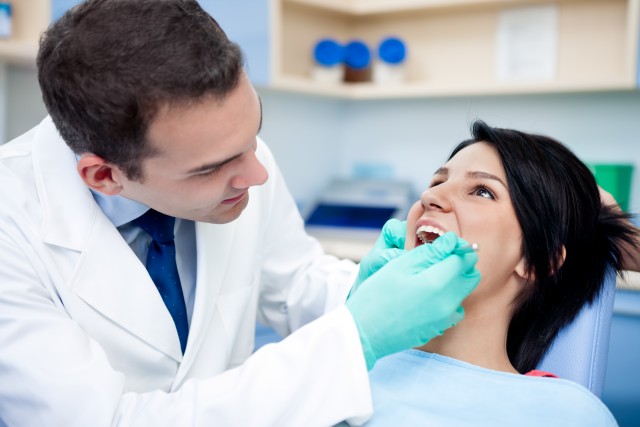
If you have restored implants for a long time, you most likely have experienced the following scenario and scratched your head, wondering what happened. Imagine you’re about to seat an implant restoration on tooth #30. You try the restoration and go through your checklist.
- Is the abutment seated?
- Is the crown seated?
- Are the margins good?
- Are the proximal contacts correct?
- How is the occlusion?
- How is the color?
After everything checks out, you cement the restoration or torque it into place if it is screw-retained. A few years go by, and you check the patient during a regular hygiene appointment when you notice that the mesial proximal contact is open.
How can this be? It was perfect when the restoration was seated …
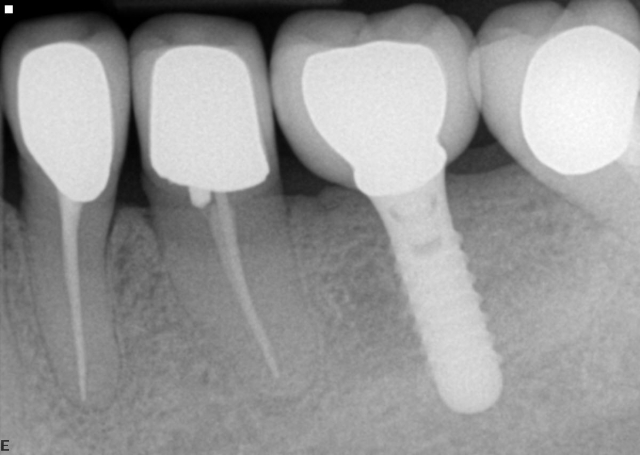
You know that the implant couldn’t have moved (since it is osseointegrated), so that must mean the teeth anterior to the implant restoration have moved. But where could they go? The lower anteriors are still coupled with the upper anteriors, preventing them from moving forward. So what is going on?
Believe it or not, the presence of diastemas developing around implant restorations is not that uncommon. The loss of interproximal contact between fixed implant restorations and adjacent natural teeth was evaluated in a 2010 paper from Koori and colleagues.1 Evaluation ranging from one to 123 months (10.5 years) showed that out of the 146 placed restorations, 43% developed an open interproximal contact, most commonly on the mesial. This paper shows that the most significant incidence of developing an open contact was in patients with an opposing dentition with natural teeth or implants, AND where the teeth adjacent to the implant restoration were non-vital and non-splinted.
What is the mechanism for the development of these open contacts? It is hypothesized that this results from mesial drift — wearing of the interproximal contacts as a result of attrition of the contacts over time.1, 2
Given that nearly half of the patients in this study developed an open interproximal contact, we must continually monitor our implant patients at follow-up visits; an open contact may induce food impaction and have an adverse effect on the peri-implant bone/soft tissue. When it is present, either the implant restoration needs to be replaced or the tooth anterior must be restored to close the contact. The downside is that if the contact opens once, there is always the chance it can open again in the future if you wait long enough.
References
- Koori, H., Morimoto, K., Tsukiyama, Y., & Koyano, K. (2010). Statistical analysis of the diachronic loss of interproximal contact between fixed implant prostheses and adjacent teeth. International Journal of Prosthodontics, 23(6).
- Wei, H., Tomotake, Y., Nagao, K., & Ichikawa, T. (2008). Implant prostheses and adjacent tooth migration: preliminary retrospective survey using 3-dimensional occlusal analysis. International Journal of Prosthodontics, 21(4).
SPEAR Membership
Try Spear Free For 7 Days
See what a Spear Membership can do for you and your team before you decide. A free 7-day trial gives you full access to Spear Online’s clinical CE courses and practice team training, so you can find the membership level that fits your practice.
Featured Digest articles
Insights and advice from Spear Faculty and industry experts