Why Do e.max Crowns Fracture?
When I train dental technicians around the world, they state that they have a small percentage of e.max crowns that fracture. It’s rare, but e.max crowns can fracture at the time of try-in or during adjustment of the occlusion. The most common reason for the ceramic to fracture is inadequate material thickness.
The manufacturers’ stated strength of any ceramic material is totally dependent on the thickness of the material and the preparation design. Manufacturers recommend very specific tooth preparation requirements for their materials in order to guarantee maximum strength and predictable longevity. Needless to say, anything less than following these recommendations will result in a weaker final restoration.
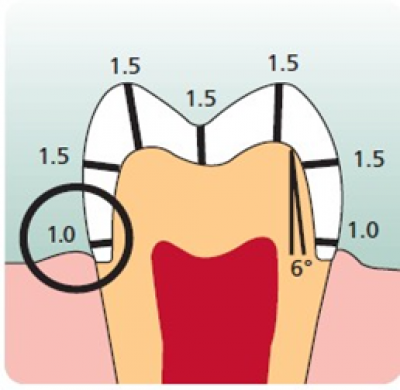
Ivoclar’s recommended tooth reduction for e.max posterior crowns is:
- At least 1.5 mm occlusal reduction for cusp tips and the central groove.
- 1.5 mm on the axial walls circumferentially in the occlusal one-third.
- At least 1.0 mm deep flat shoulder margin. Chamfer or feather edge finish lines are contraindicated.


at try-in light body or “check fit” GC /finger pressure only….AFTER contacts correct(fine unwaxed).. Adjust prep whenever possible and give lab your mm clearances stated. Be sure lab is using sufficient die spacer! Never have pt bite at try-in without check fit/LB in!!! An art of insertion that most seem clueless to master. If it has a problem going in /down the DOCTOR had better earn the title.!!!
I realy cant find the explanation of the question you have made: “Why do EMAX crown fracture??”
You are telling this like if EMAX is the perfect and definitive dental material that, never should fail, but EMAX its just another one, of the thousands of dental ceramics in the world. No worst, and no better than others. The only different thing that EMAX haves, is A LOT OF MARKETING AND PUBLICITY.
Dentist usualy “buys” a product if you show that product to him like the best of the best, but one thing is to believe what the manufactures says, and one diferent thing is to check and test by your self the properties that evey material haves and decide if this material is apropiated for your patients.
EMAX crowns, will fail now, and ever, like any other pure ceramic crown of the world, if you dont follow the correct procedures of manufacturing and preparing the tooth reduction.
A very simpler explanation of why pure ceramics fractures is that the dentist, didnt clean very well the dental preparation before place the crown. This is a GLASS crown, because every dental porcelain is nothing else than GLASS (leucite, fluorapatite, feldespat, or whatever you use), so if the dental preparation is not clean, then, when you place the crown, there will be some premature contacts of impurities with the internal surface of the crown, and, when you give the crown a minimal down force to place the crown, the crown just break, because as any glass, the dental porcelain haves a very small elongation point.
Of course there is also the dentist confusion to call PURE CERAMIC to EMAX over zirconia, or porcelain over Alumina….. Porcelain over zirconia, or over alumina IS THE SAME than porcelain over metal. Its a composite of PORCELAIN over NON CERAMIC STRUCTURE (metal, zirconia, or alumina).
If you want a FULL ceramic restoration you need a pressable ceramica. The presable ceramica cames in ingots that are a reinforced version of the veneering porcelains that are designed to cover the pressed copings. Empress, Ceramco IC, Ceramco 3 press, Noritake EX3 press etc, etc, etc.
The only diference between zirconia, and metal, is the color of the structure, but both structures needs a preparation to mask the unatural color that every metal or zirconia structures haves. One need to mask the extreme white chalk looking, and the other , the dark metal looking.
So, if you need an anterior tooth, and you think that zirconia is the best aesthetic option then YOU ARE TOTALY WRONG!!!!! Because if you want that the margin of the shoulder looks natural, you will anyway need to make a porcelain shoulder reducing the zirconia margin, just like you will do in a metallic structure to aply a margin porcelain….
So, for anterior pieces, the best option, are pressable ceramicas that are CERAMIC OVER CERAMIC (STRATIFICATED PORCELAIN OVER PRESSED CERAMIC).
All this concept problemas are caused because dentist are too bussy going to medical congresses, but never take a minute to know how a porcelain crown is maded, so, as they dont care about the process of makin a crown, the just dont know how the hell to prepare the patient for each different option that dental laboratories can offer, and then…. the failure of a dental restoration for the dentis is just a mistery, and the best and easier option, is to blame the dental technicial work.
TPD Nicolás Pérez Fiorentini.
We have been cementing monolithic e-max crown over feather-edge prep for more than 5 years with excellent results and basically no complications. This is the ref of our publication in the J. of Adhes. Dent.: Bonding Lithium Disilicate Ceramic to Feather-Edge Tooth Preparations: A Minimally Invasive Treatment Concept
Davide Cortellini / Angelo Canale
J Adhes Dent 2012; 14: 7–10.
In our experience the following elements are of crucial importance in order to avoid fractures:
1) maintaining adequate occlusal thickness: at least 1.5mm
2) maximum care should be taken during the try-in, avoiding to force the restoration in situ if the interdental contact points are too heavy; adjust them until the restoration fits smoothly.
3) we perform occlusal adjustment only post cementation
4) always etch and silanize the inner surface of the restoration prior to cementation. Always use a resin cement.
Following these rules we are not finding any technical complication using e-max restorations in various clinical conditions.
You are totally wrong. I have been a dentist since 1980. I have seen a lot of stuff come and go over the past three decades. I was totally devoted to PFM because of strength and durability. However, you are right about masking metal, but dead wrong about masking Zicronia. Particularly the 3M product, Lava.
The strength of Zirconia is in excess of 1000 Mega Pascals. This is well in excess of the max biting force in molar area of 450 Mega Pascals. Hence, one does not need to bond for strength, which is always suspect. This is a huge advantage.
While the core is caulking white, it is translucent in thicknesses of under 1mm. I have placed hundreds of Lava crowns and no fracture or delamination. Can not say the same for any other “all ceramic” product. Empress I or II or E-max, all fail. I finally, I have never had a patient mention color issues with Lava, but we suffered them with PFM. But patients will be most unhappy with a broken crown, even after it has severed them for 30 years. I still employ full gold on molars where the patient agrees to it. My second choice in molars is PFM. But considering the success I have had over the past six years with Lava, it is a very close third. In the anterior area, Zirconia is the only way to goes. I have thousands of photos to back up my claim. Just visit my site. So there!